Antarctic sediment core records wildfires from 90 million years ago
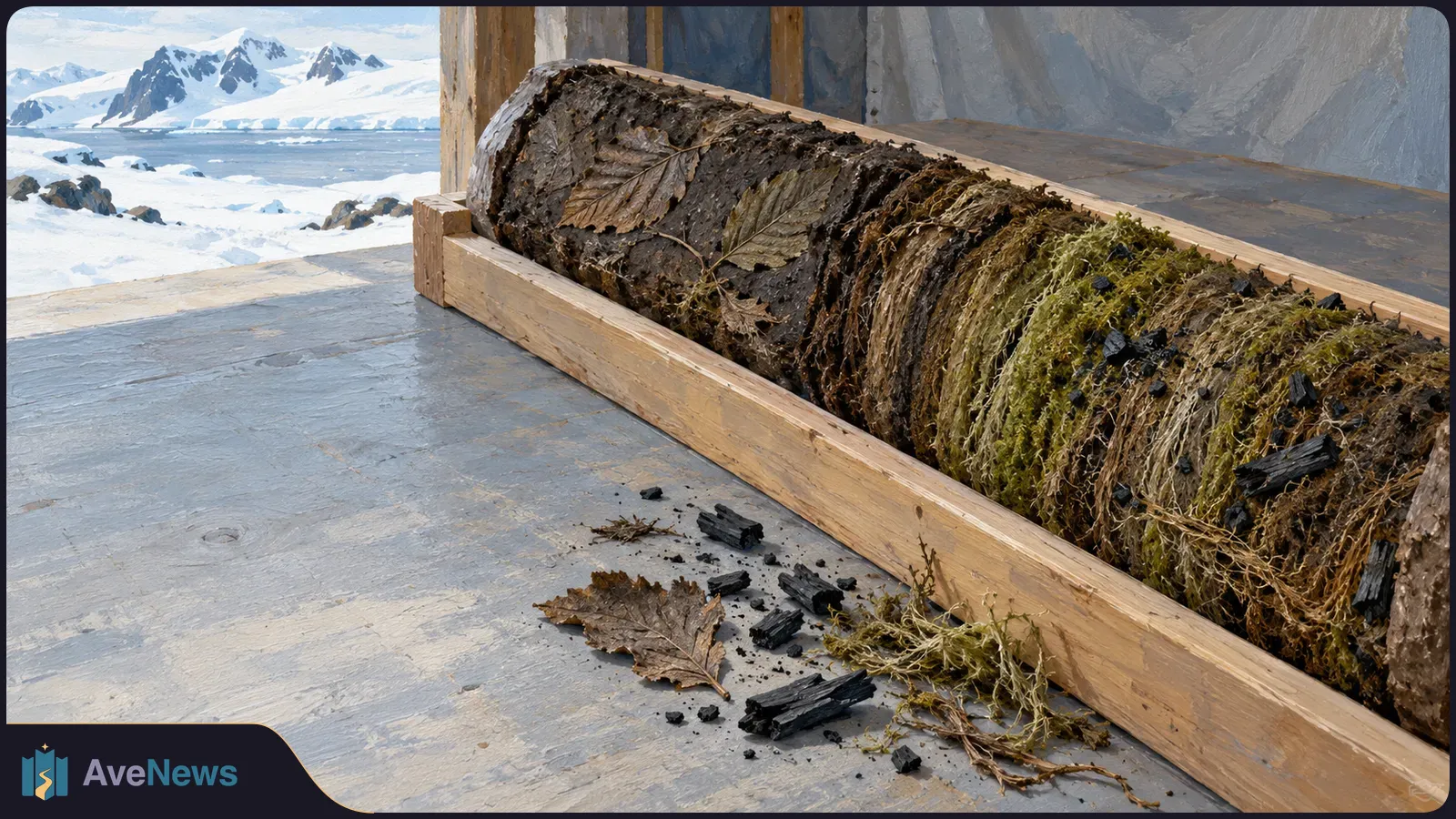
Charcoal, chemical residues and plant fossils trace surface fires and a shift from rainforest to peat bog. Researchers suspect more frequent fires helped sustain that change.
Charcoal, chemical residues and plant fossils trace surface fires and a shift from rainforest to peat bog. Researchers suspect more frequent fires helped sustain that change.
A seafloor sediment core near West Antarctica holds evidence of wildfires around 90 million years ago, when the landscape supported a humid rainforest rather than ice. The findings add a fire history to an earlier reconstruction of that forest and trace its later transition to a moss-dominated peat bog.
Eos reported the study, published in Communications Earth and Environment, on 1 October 2026. The approximately 30-meter-long core was drilled roughly 900 kilometers from the South Pole. Johann Klages, a sedimentologist at the Alfred Wegener Institute, described the findings as the southernmost evidence of wildfires recorded so far.
The researchers first noticed tiny charcoal fragments while using strong acids to remove nonorganic material from the sediment and isolate pollen and spores. High-powered microscopes revealed plant cell walls in the fragments, showing that they were burned plant material. Spectrometry, a technique for identifying chemical substances, also detected residues left by partially burned plants.
Amber—fossilized tree resin—provided another clue. In some samples, amber covered former tree bark. Klages explained that resin commonly covers bark after a tree suffers an injury from an external force, such as fire. That makes the amber supporting evidence, rather than a sign unique to burning.
To infer the type of fire, the team examined how light reflected from the charcoal particles. The results pointed to lower-temperature surface fires, rather than fires burning underground in peat or crown fires burning through the tree canopy.
An earlier study, published in 2020, used fossil pollen and preserved roots in the same core to identify the ancient rainforest. In the later study, chemical signatures, pollen and spores revealed how its vegetation changed. Lower, older layers contained evidence of conifers characteristic of a temperate rainforest. Higher, younger layers showed a sharp increase in ferns and sphagnum moss, commonly found in peat bogs.
Peat bogs are typically acidic. Measurements showed that pH, the scale used to measure acidity, fell during the vegetation transition. That change indicated more acidic conditions, consistent with the developing bog.
Fire occurrence increased alongside the spread of bog vegetation and the rise in moss spores. Ulrich Salzmann, a paleoecologist at Northumbria University who studies past ecosystems, said the researchers suspect that more frequent fires helped sustain the transition by keeping the landscape open. The coinciding trends support that hypothesis, but do not by themselves establish the mechanism. The reconstruction concerns the landscape recorded in this one core.
Analysis
Ellen Currano, a University of Wyoming paleoecologist who was not involved in the study, praised the combination of different geological and fire-history indicators. She said using them together yielded more understanding than relying on any one indicator alone.
Modern peat bogs also experience low-intensity surface fires, giving researchers a comparison for the Antarctic record. But the Cretaceous climate was markedly different, with warmer temperatures and higher carbon dioxide and oxygen levels. The similarities help explain the ancient ecosystem; they do not establish how today’s peatlands will respond to future warming.

A trial with two brain-coral species points to a small-scale protection tool, but less paling does not necessarily mean less loss of the algae corals rely on.
3 min

The plan would remove a national framework for investors to put recommendations to shareholder votes. Public comments are open through November 20.
3 min
Harvard physicist Matthew Schwartz reports results from selected research tasks, while warning that automated checks and scientific interpretations can be wrong.
3 min