Loading… Բեռնվում է…
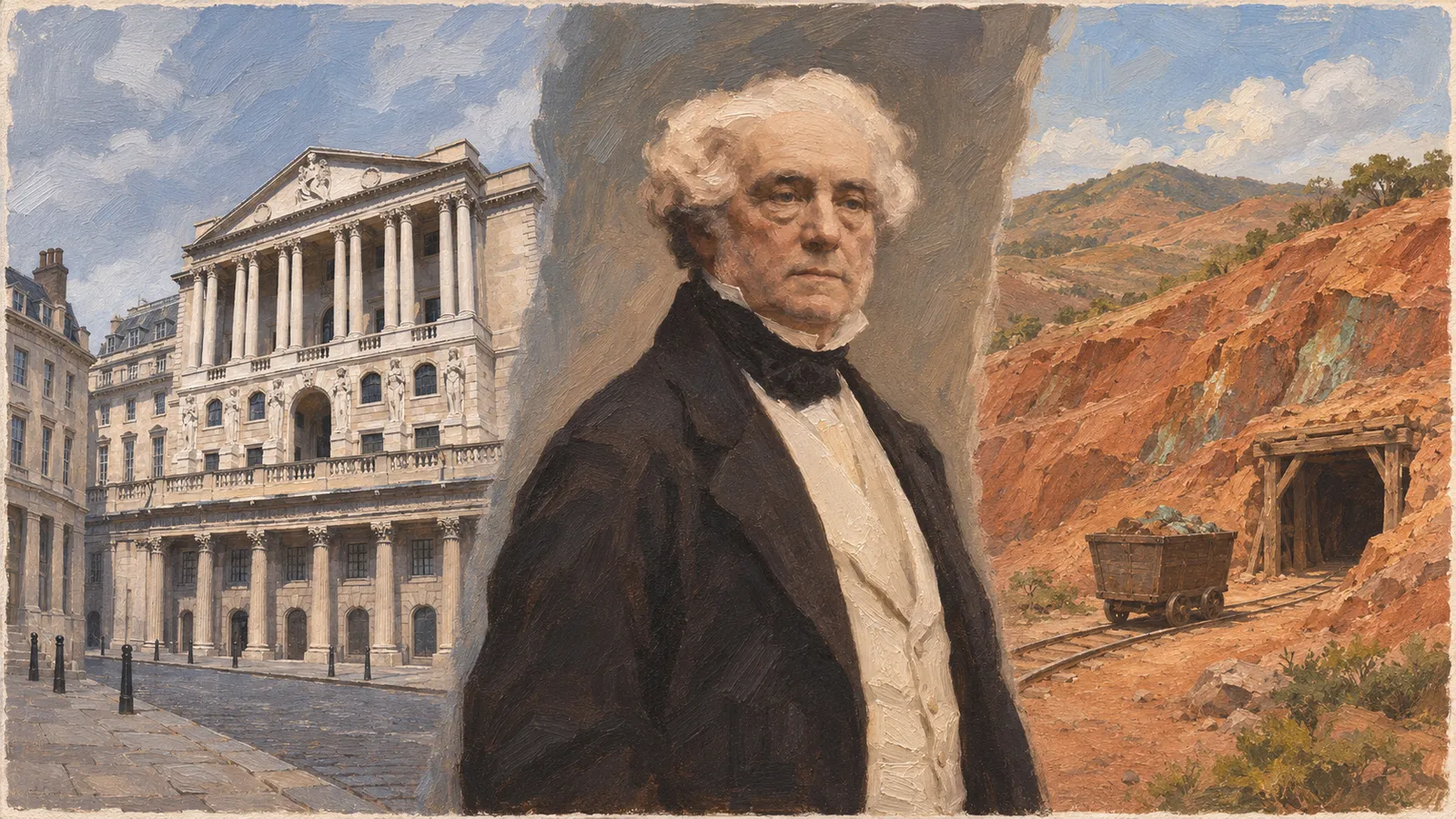
Charles Pascoe Grenfell and William Thompson pursued private mining interests in Cuba after Britain abolished slavery in most of its empire, Chris Evans’s research finds.
Bank of England directors Charles Pascoe Grenfell and William Thompson profited through private businesses that exploited enslaved miners at Cuba’s El Cobre copper mine, historian Chris Evans has found. They acted privately, not on behalf of the Bank. The Guardian published the findings from Evans’s research on 22 November.
Their interests continued after Britain banned its trade in enslaved people in 1807 and legislated to abolish slavery in most of its empire in 1833. Spain had signed a treaty banning the trafficking of enslaved Africans to Cuba in 1817, but slavery itself remained legal there at the time.
Grenfell was a partner in the Cobre Mining Company, which mined and exported ore, and in Pascoe, Grenfell & Sons, a Swansea smelter that bought imports from the mine. Thompson directed the Royal Santiago Company, an ore exporter. The Cobre company reopened the abandoned mine in the early 1830s; the British Royal Santiago Mining Company opened an adjacent concession.
Cobre investors who held their shares from the outset received £102 in dividends for every £40 share between 1836 and 1865. In the 1840s, Cuba was the UK’s most important foreign source of copper ore, and copper was important to Manchester’s cotton industry, railways and telegraphy.
Evans found that men and boys were held in prison conditions at El Cobre. There was daily violence and torture, and people were employed to catch miners who escaped toward the mountains. Evans said the miners were likely trafficked on illegal voyages from the Bight of Biafra, in present-day Nigeria. The Guardian said the death rate made it likely that thousands of Africans were exploited at the mine.

The British and Foreign Anti-Slavery Society pressed for legislation in 1843 intended to stop British subjects from owning enslaved people in other jurisdictions. After mining interests lobbied Parliament, the law allowed companies to retain enslaved workers as property and hire others.
Cuban revolutionaries captured El Cobre from Spanish forces in November 1868, weeks after the start of the Ten Years’ War on 10 October, when Carlos Manuel de Céspedes proclaimed Cuban independence from Spain. A rebel commander proclaimed the miners’ emancipation on New Year’s Eve, and formerly enslaved workers later joined Cuba’s liberation army. Neither Grenfell nor Thompson appears to have faced legal penalties for their involvement, the Guardian said.
Evans, a former University of South Wales professor, explores Britain’s overlapping histories of slavery, capitalism and missionary Christianity through Grenfell and two cousins in his book Slavery’s Long Goodbye: Capitalism, Nationalism and Christianity in the Age of British Emancipation. He argues that British capital supported slavery elsewhere in the Western Hemisphere as Britain wound down its own slave system.
We have previously acknowledged the role of former governors and directors in the slave trade.
 Guardian World
The institute says the relatively intact iron armor is the first of its kind found together in a Gyeongju tomb. Its team also estimates that at least 2 people may have been buried alongside the principal deceased.
3 min

Summit president Murat Kurum said the proposed decisions were not adopted after objections to a text that omitted fossil fuels.
6 min

The communities say they have full confidence in the argument, which Anthropic mathematician Levent Alpöge developed with Claude. Their assessment advances scrutiny of the longstanding problem; broader mathematical acceptance remains a condition for prize consideration.
3 min
