Angled obstacle reverses energy cascade in brine-shrimp experiment
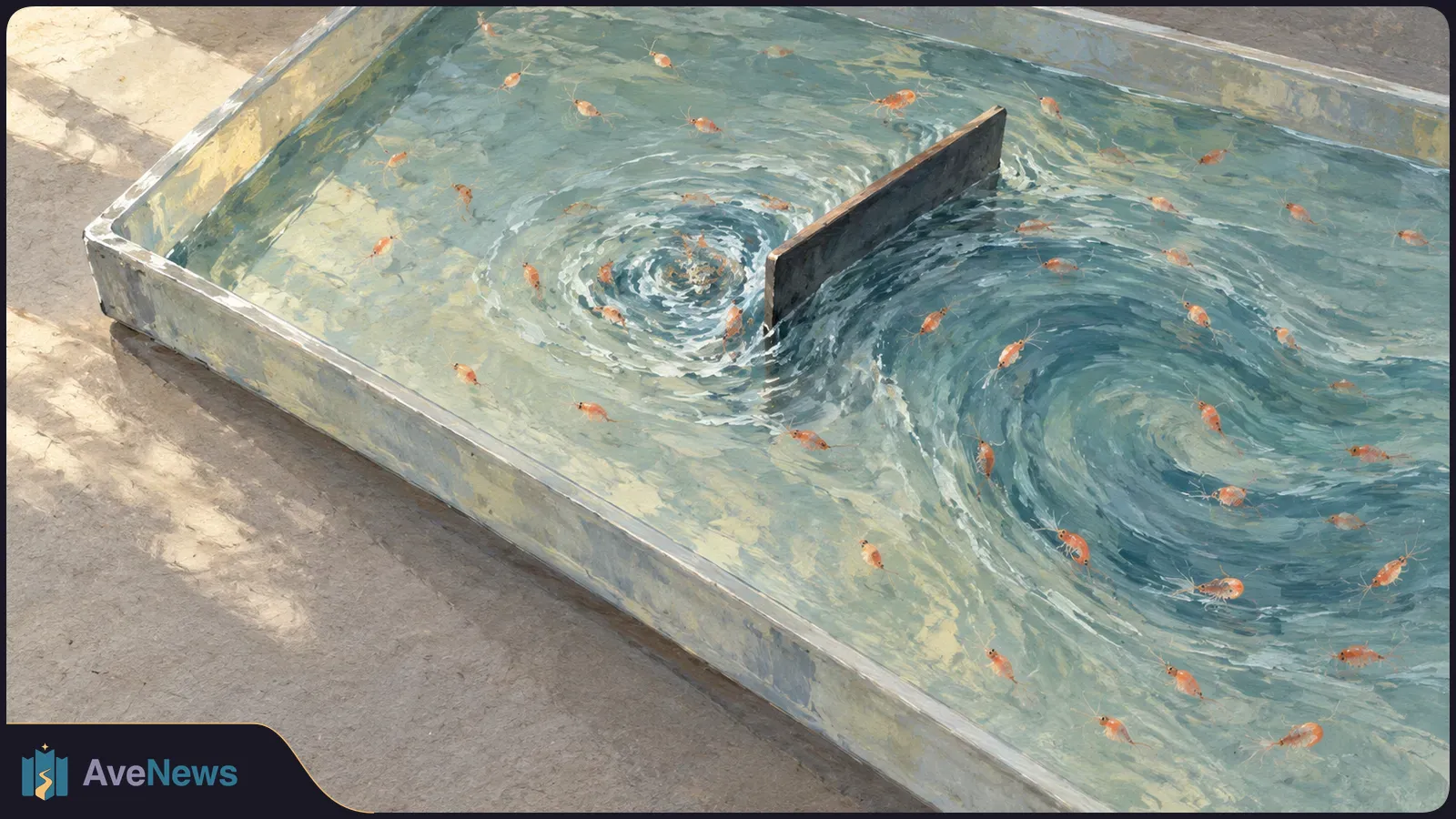
Pittsburgh researchers reportedly changed how energy moved between water swirls in a two-dimensional system. The finding suggests that flow geometry can control the direction of that transfer.
A small obstacle placed at a suitable angle let University of Pittsburgh researchers reverse the direction of energy transfer in a two-dimensional brine-shrimp system, Quanta Magazine reported on October 2, 2026. The experiment suggests that this direction need not be fixed: changing the geometry of the flow can change how energy moves between different-sized swirls.
Turbulence is a fluid’s irregular, swirling motion. Its swirls, called eddies, can pass energy from one size scale to another—a process known as an energy cascade. The direction matters because it determines whether energy feeds larger movements or passes into progressively smaller ones.
In the usual three-dimensional case, large eddies feed smaller eddies. Eventually, viscosity—the fluid’s resistance to motion—dissipates the energy as heat. Two-dimensional turbulence usually transfers energy the other way, from small eddies to larger ones. The Pittsburgh researchers reportedly reversed that small-to-large transfer in their system.
Brine shrimp, also known as sea monkeys, are roughly a centimeter long and live in salty water. They swim by beating their legs, stirring the surrounding water as they move. That makes them an example of “active matter”: things that propel themselves and inject energy into their surroundings.
Study leader Lei Fang and Xinyu Si investigated how biological swimmers mix materials in turbulent fluids. Their starting hypothesis was that turbulence generated by tiny organisms plays an underappreciated role in mixing large natural bodies of water. The reported experiment concerns controlling energy transfer in a two-dimensional system; it does not establish that broader hypothesis.
In an independent assessment reported by Quanta, Gregory Falkovich, a physicist at the Weizmann Institute of Science and a pioneer in two-dimensional turbulence research, said the discovery exploited a fundamental mathematical description of how forces interact to move energy through a system.
This is a beautiful and skillful experimental work.
The detailed experimental geometry, measurement procedure and quantitative results are not provided in the available source account. Those details matter for understanding the conditions under which the reversal occurs and the size of the effect.
Quanta describes extensions to larger, more chaotic systems, including three-dimensional flows, as possibilities. It also identifies pollution control and drug design as potential applications, not demonstrated practical outcomes. Whether the same control of energy transfer can work beyond this two-dimensional system remains an open question.
Record renewable electricity generation reduced the need to burn gas, but the estimated import value is not a measure of household bill savings.
3 min
The coalition seeks to preserve greenhouse-gas emissions limits on coal- and gas-fired plants and disputes EPA’s claim that it lacks authority to regulate those emissions.
3 min

The first interim figures cover one school-year cohort, not everyone eligible for the wider offer. UKHSA is urging eligible young people to complete both doses.
2 min
Correction ·
House style applied: Armenian punctuation, date and money forms.
Correction ·
Corrected spelling and punctuation in the Armenian text.