
Chicxulub’s hot-water system may have lasted eight million years
Rock dating and cooling simulations suggest a longer window for an impact-created habitat, but do not establish that organisms lived in the crater.
Rock dating and cooling simulations suggest a longer window for an impact-created habitat, but do not establish that organisms lived in the crater.
The asteroid impact that wiped out non-avian dinosaurs may also have kept water circulating through hot rock beneath the Chicxulub crater for about eight million years. A study published in Communications Earth & Environment suggests this hydrothermal system lasted four times longer than the previously estimated two million years, according to Ars Technica.
That longer lifetime matters because heat and nutrients can make such systems suitable for microorganisms. The research examines how long those conditions could have persisted; it does not establish that organisms actually inhabited the crater.
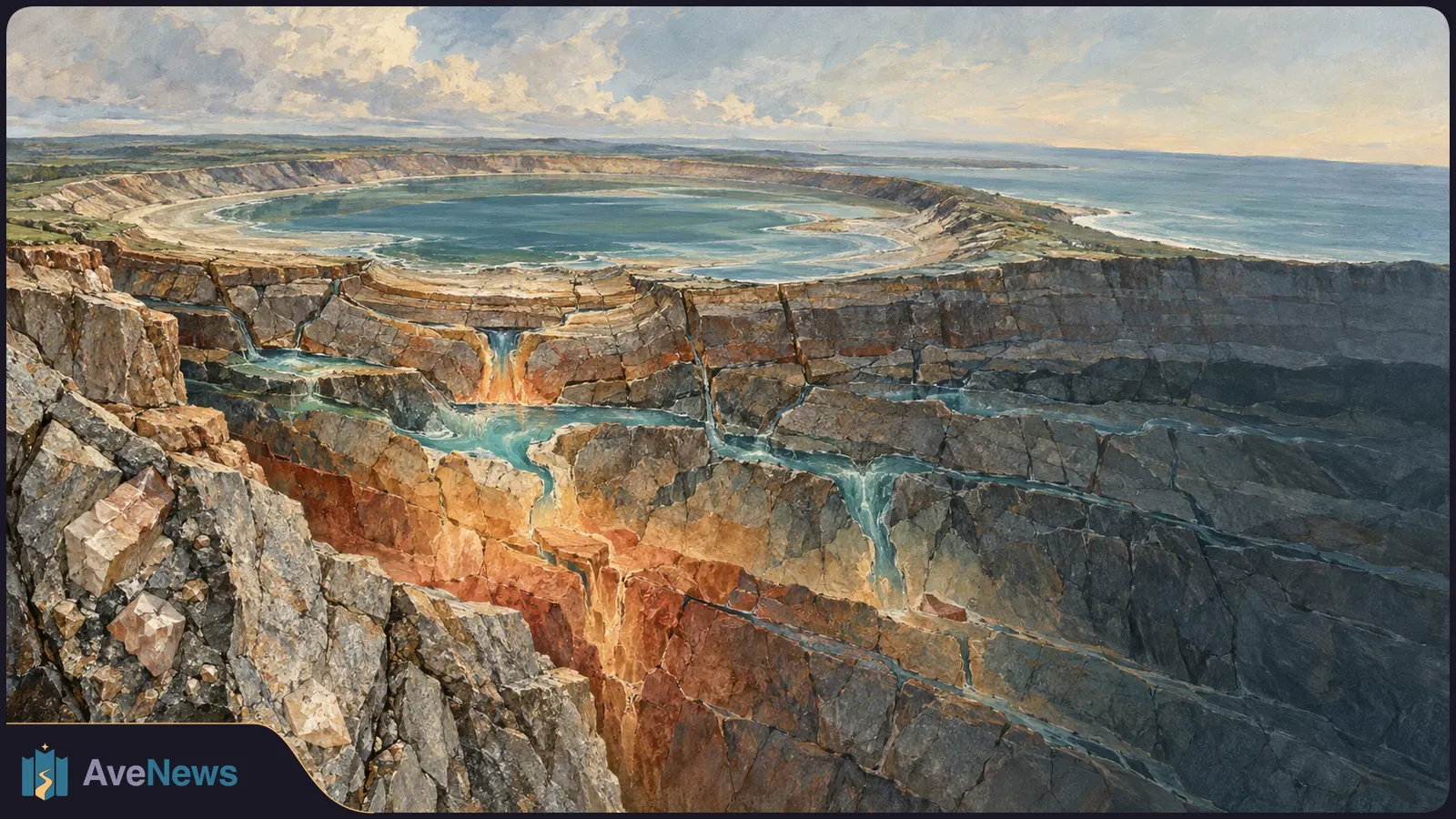
The asteroid struck what is now the Yucatán Peninsula about 66 million years ago, causing the extinction of non-avian dinosaurs and many other species. Beneath the impact site, the collision melted large amounts of rock. Seawater exposure made the rock porous, and hot water entered those pores, forming a hydrothermal system.
The team was led by Annemarie Pickersgill, a geologist and planetary scientist at the University of Glasgow’s SUERC Center for Isotope Sciences. The researchers analysed feldspar, a mineral containing potassium, from drill samples recovered about 1 kilometre below the site.
Using potassium–argon dating, they measured radioactive potassium-40 and the argon-40 it produces as it decays. Argon gas can escape from molten rock, so the amounts retained in a sample help estimate when the rock cooled and solidified. The analysis indicated that the system remained heated from about 66 million to 58 million years ago.
Computer simulations provided a second estimate. At a depth of 1 kilometre, temperatures fell to 90°C after 1.5–2.3 million years; cooling below 50°C took up to five million years. Hot-water flow diminished substantially after six million years and ceased by eight million years. These results were consistent with the mineral dating.
Analysis
Pickersgill says longer-lasting hydrothermal activity gives more time for prebiotic chemistry—the chemical reactions that precede life—and for life to develop. It also gives microorganisms more opportunity to establish colonies and spread beyond their point of origin. That is a possible consequence of sustained heat and water, not a finding that Chicxulub hosted life.
Chicxulub is relatively small compared with the impact basins expected on early Earth and observed on other planetary bodies, Pickersgill notes. She suggests those larger impacts could have created even longer-lived hydrothermal systems, sustaining the temperatures and water flow needed for potential habitats for millions of years.

The NIH–NASA competition seeks better measurements in laboratory drug-safety models, with submissions scheduled to open on 15 December 2026.
2 min

The programme brings together national laboratories, universities and industry partners, with plans for a sensor-equipped test bed and self-adjusting pilot production lines.
2 min

Previously seen only through its infrared heat, the dusty feature is visible in reflected starlight, allowing researchers to test a possible collision origin.
4 min