Loading… Բեռնվում է…
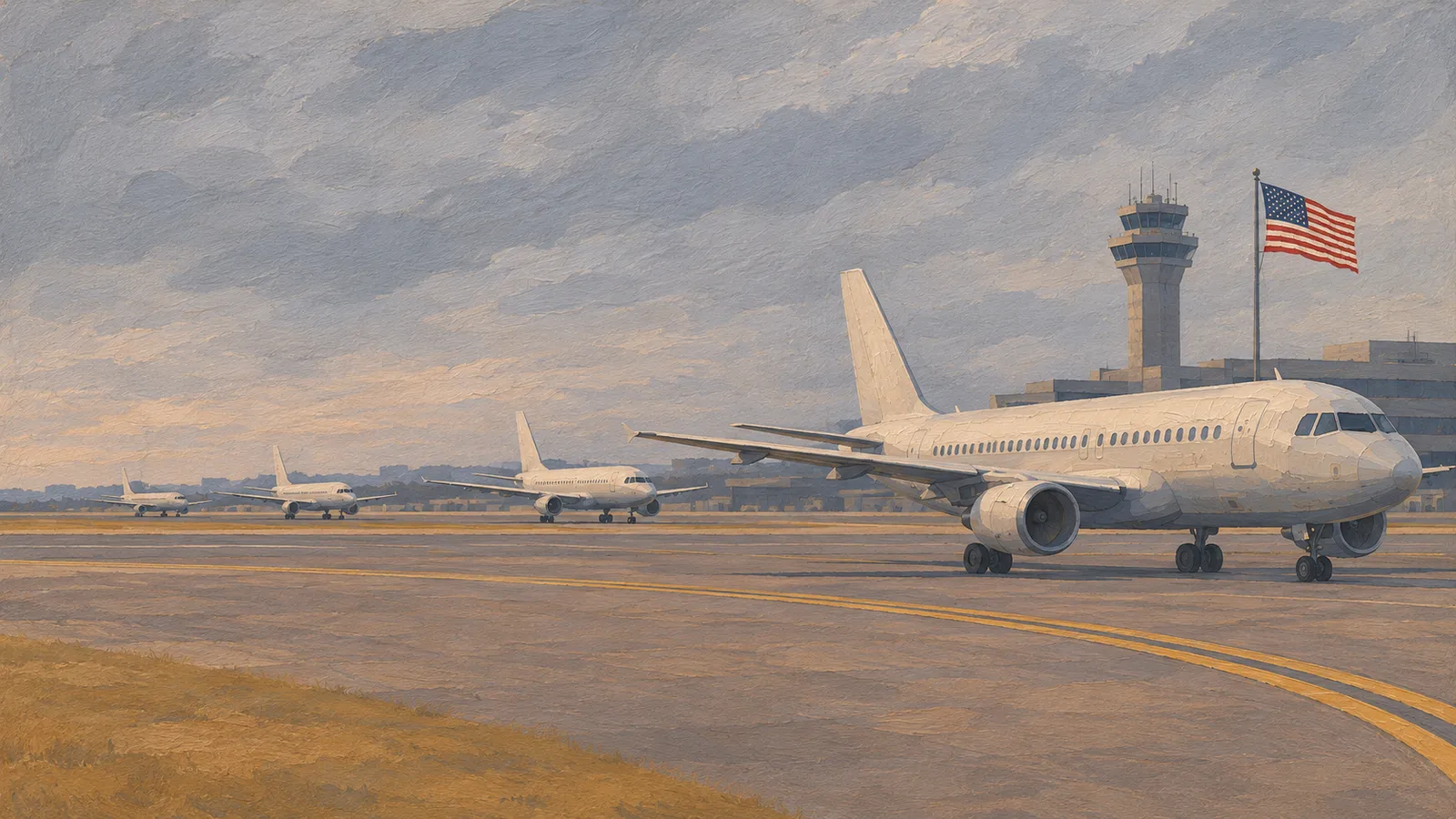
The US Federal Aviation Administration has lifted its nationwide departure halt after more than four hours, but residual disruption could affect entertainment events. Some Europe-bound flights had already departed, and airborne planes could land. Sean Duffy said communications problems affected all Air Route Traffic Control Centers; the agency said international flights would be handled case by case before lifting the nationwide halt.
The Federal Aviation Administration (FAA) lifted its nationwide halt on departures on the evening of 13 November, allowing flights to resume after more than four hours. The agency had imposed the stop for safety after air traffic control communications problems.
Before the nationwide announcement, the FAA halted traffic in Chicago over air traffic control communications problems. Duffy said FAA technicians were investigating.
The previous nationwide stop came in January 2023, when a system that supplies pilots with information relevant to their flights malfunctioned. That pause in domestic departures lasted less than two hours.
Before the latest stop was lifted, some international flights had departed from New York’s John F Kennedy, Boston Logan and Philadelphia airports, and flights had left for Europe from Newark and Washington Dulles, and planes already in the air had been allowed to land. The FAA said it would handle international flights case by case. Transportation Secretary Sean Duffy said the communications issue affected all air route traffic control centers, which direct planes between airports.
The FAA called it a temporary telecommunications outage and said every flight had been accounted for. Homeland Security Secretary Markwayne Mullin also said every flight was accounted for and incoming international flights would be handled case by case. Duffy promised immediate updates as information became available.
San Francisco International Airport said flights across the Pacific, including to Hawaii and Asia, had been cleared to depart before the nationwide halt ended. Among Europe-bound departures, a Delta flight left New York for Rome at 18:23 Eastern time, while a British Airways flight left Philadelphia for London at 18:32, three minutes early.
Eurocontrol said departures to US airports from its 42 member states were suspended at the FAA’s request; a subsequent notice set the suspension until 05:00 UTC on Saturday. Canada’s air navigation provider NAV Canada introduced traffic-management measures at Toronto Pearson, Montreal-Trudeau, Calgary and Vancouver. It said its systems were operating normally and advised travelers to expect delays and check with airlines.

Permission to depart did not immediately restore airline schedules. Duffy said airlines still needed to reschedule flights and move aircraft and crews into position. FlightAware counted more than 8,000 cancellations on Friday, while airlines canceled 4,500 US flights and delayed 4,400 on Saturday, 14 November.
The stop was lifted at about 20:15 Eastern time Friday, after which a limited number of domestic flights departed. American, United and Southwest began resuming flights Friday night, and Delta also said it was restarting. Southwest said it was resuming a limited number after consulting the FAA. The agency said it had thoroughly tested systems for stability and reliability before clearing departures.
On Saturday, United announced a stop for its own flights at Chicago O’Hare and Delta did the same at New York LaGuardia to address congestion and gate issues. United had earlier told passengers they could check flight status or rebook through its link or app. In Las Vegas, stranded passengers seeking alternatives formed long lines at airport car-rental counters. Aviation analysts said restoring schedules could take days.
FAA Administrator Bryan Bedford said 16,000 flights were delayed across Friday and Saturday. Airlines issued waivers allowing passengers to rebook for later dates without charge. Bedford said the FAA was working with aviation stakeholders and that affected passengers would either be rebooked or receive a full refund.
In an earlier snapshot, the separate tracking service FlightRadar24 counted more than 4,700 cancellations and 10,000 delays on Friday, with another 700 flights already canceled for Saturday.
In another earlier snapshot, FlightAware counted 6,816 cancellations and 8,553 delays on Friday; by 11:00 Eastern time Saturday it counted more than 4,000 Saturday cancellations within, into or out of the US. An earlier France 24 report put Saturday cancellations above 2,000. FlightRadar24 also reported more than 6,600 cancellations and 8,600 delays, with another 1,500 flights already canceled for Sunday.
In still earlier FlightAware snapshots, The Guardian reported day-wide counts of 10,343 delays and 1,479 cancellations within, into or out of the US, then 10,543 delays and 3,580 cancellations, not all of which were established to have been caused by the outage.
US-bound flights from Sydney, Melbourne and Brisbane were delayed on Saturday. Passengers due to leave Melbourne for Los Angeles shortly after 10:00 faced a delay of more than two hours. Sydney flights had been held on the tarmac, some for up to three hours, over concern they could not land in the US; they were gradually cleared to depart. By 15:00 local time, all delayed Melbourne flights and two of four delayed Brisbane flights had departed. Qantas advised passengers with upcoming US flights to check its website, while Brisbane Airport advised North America-bound travelers to contact their airlines.
The disruption also changed college football travel. The Southeastern Conference moved Ole Miss’s game at Oklahoma from Saturday to Sunday, 15 November, at 13:00 Eastern time (22:00 Yerevan time). The conference said Ole Miss could not leave Friday night and its charter company could not accommodate a late departure after the stop was lifted, delaying the team’s departure until Saturday afternoon.
The Ole Miss–Oklahoma game in Norman had originally been scheduled for Saturday at 16:15 Eastern time. Auburn took buses to Mississippi State after its flight to Starkville was delayed; the conference moved kickoff from noon to 16:15 to give it more travel time. Washington departed late Friday for Michigan State, where Saturday’s game was delayed 75 minutes to 17:30 Eastern.
Oklahoma athletic director Roger Denny criticized the change, saying it disrupted fans' plans and that the conference had threatened the team with a forfeit if it did not agree.
Arizona State left its plane and went home to rest, planning to fly to Orlando on Saturday morning; its game against UCF moved from 15:30 to 17:30 Eastern. Kansas at West Virginia moved to 15:30, while a source told ESPN that Baylor at BYU moved to 19:00. Big 12 had earlier said it was evaluating possible schedule changes.
Oregon State initially had not left for Idaho for its 18:00 Eastern Saturday game at Boise State. The team later started by bus, returned to the airport and planned to fly to Boise Friday night, a source told ESPN. North Texas switched to buses for its game against UTSA in San Antonio; Tulane planned five buses for the 350-mile trip to Houston to play Rice. Purdue also chose buses after its flight to Iowa City was delayed, sources told ESPN.
Earlier, Baylor, Kansas State, Utah, Arizona State, Ole Miss, Tennessee, Texas, Minnesota and Washington were still waiting to leave for weekend games. Wyoming was grounded before its game at UTEP, and Colorado State waited at Northern Colorado Regional Airport to travel to Washington State. The Atlantic Coast Conference said all its visiting teams had reached their destinations before the stop. In basketball, the Cleveland Cavaliers postponed their return from Miami until Saturday morning, with their arrival scheduled about eight hours before hosting the Dallas Mavericks.
Deadline said lingering travel problems could also affect entertainment events, and that some people traveling to the Texas Book Festival had been stranded at airports.
The outlet identified Sunday’s Governors Awards in Hollywood and Saturday’s Rock & Roll Hall of Fame induction ceremony in Los Angeles as potentially affected. It said it understood that Monday’s ninth annual Critics Choice Celebration of Black Cinema and Television in Los Angeles would not see an impact on its program.
Duffy said switches and routers in the older communications system became overloaded and produced inconsistent data, interrupting communications and radar. He later said the disruption began when FAA contractor L3Harris installed at least one router during routine maintenance to replace copper telecommunications lines with fiber-optic cable at a remote facility.
Duffy said the changeover flooded routers across the system with more than 1,000 connection attempts every four to five seconds, disrupting some radar feeds and prompting the safety stop. At a White House briefing, he described old switches, routers and copper lines dating from the 1980s and said the system was shut down after inconsistent data appeared.
Duffy said officials were still determining whether an installation or user error, or a faulty router, was responsible. He said systems came back online after the work at the remote facility was isolated. L3Harris did not immediately respond to a request for comment from Fortune.
CBS News reported that an update to the private network connecting air traffic control caused it to reboot and crash, causing the communications outage. The Register reported that L3Harris operates the FAA telecommunications infrastructure and had not responded to its request for comment. Officials continued investigating after the stop was lifted; the precise equipment fault remained unresolved.
Bedford said the system was stable and that officials had seen no evidence of malicious activity or a superintelligence (SI)-related cause. The FAA said it was conducting additional tests with L3Harris for other risks.
At Saturday’s briefing, Bedford said officials had concluded it was not a cyber issue; he said the White House situation room and national security infrastructure had been activated and the FBI was investigating at facilities. Duffy said it was not a foreign actor, pointing to the system’s recovery after the originating location was isolated and taken offline. He also denied that the new SMART system, which uses SI, caused the problem.
Mullin said officials had seen no evidence of a cyberattack and the problem appeared mechanical. He said there was no connection to Microsoft; earlier, he had said there was no indication of a malicious attack but officials were not ruling anything out. He tentatively suggested that new equipment introduced while the FAA patched the system had overwhelmed older equipment.
Bedford said airline partners expected to restore full schedules by the close of business on Sunday. Duffy also asked Congress for $50 billion in emergency funding to rebuild the air traffic control network, after a separate formal request for $30.1 billion to modernize it.


Sean Duffy described the work in El Dorado in a preliminary account of the network problem behind the nationwide flight departure halt on 13 November.
1 min



