
Experimental implant network sends signals through body tissue
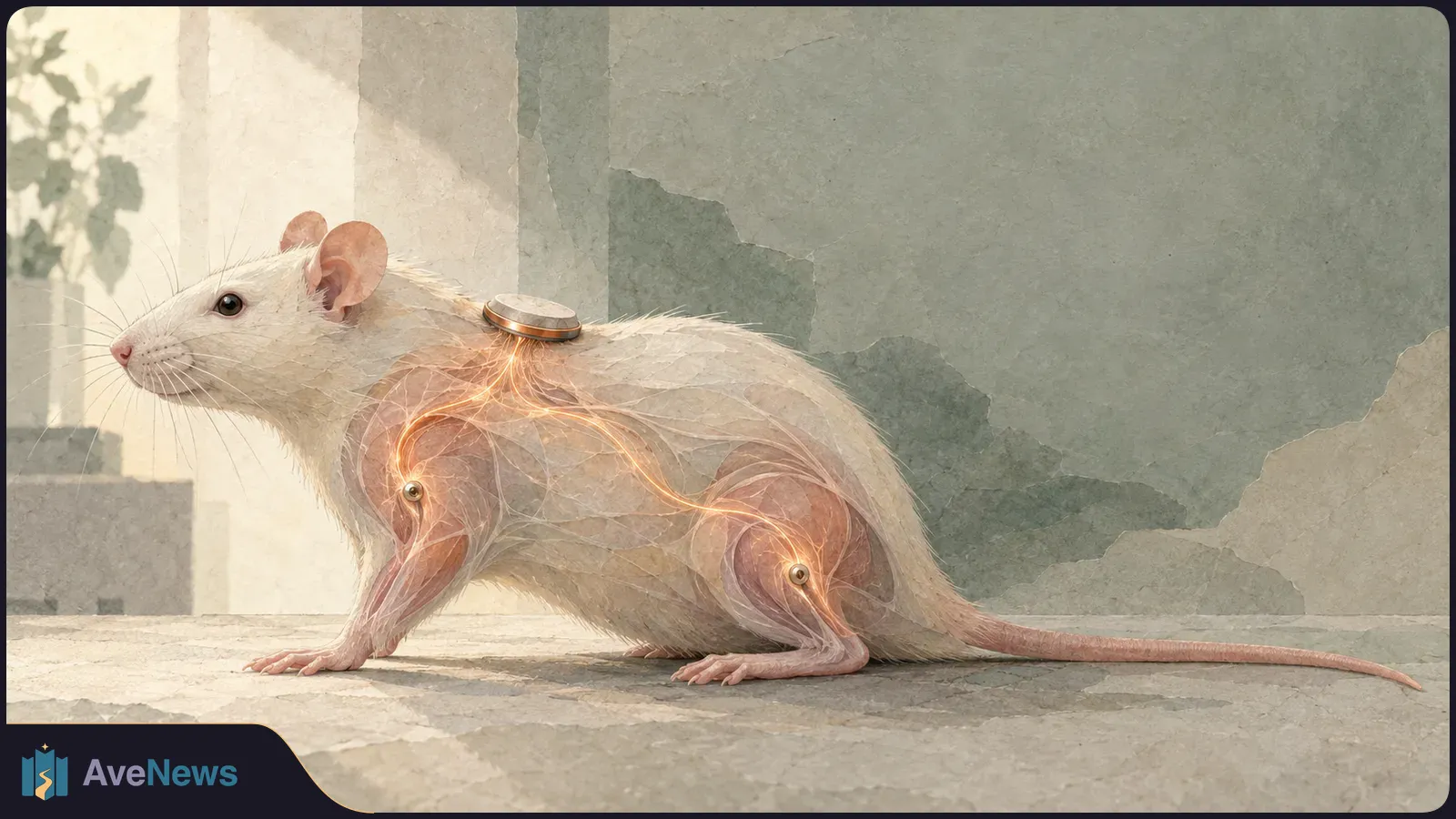
A wearable hub coordinates small sensors and nerve stimulators without radio links. Rat experiments demonstrate the idea, but human safety and treatment benefits remain untested.
A wearable hub coordinates small sensors and nerve stimulators without radio links. Rat experiments demonstrate the idea, but human safety and treatment benefits remain untested.
Georgia Tech researchers have demonstrated a way for small medical implants to coordinate through electrical signals carried by body tissue rather than radio waves. In one rat experiment, a wearable hub linked front-leg movement sensors to implants that stimulated the corresponding hind legs. The work demonstrates a connection between sensing and stimulation in different body parts, not a treatment tested in people.
The system is called SWANS, short for Smart Wireless Autonomous Networking System. Ars Technica described the study, published in Science, in a September 30 report. SWANS uses ionic conduction—the movement of electrically charged particles—to carry pulses through ordinary tissue. It does not use nerves as its communication pathway.
Communicating implants commonly use Bluetooth Low Energy or near-field communication, known as NFC. Study co-author Alex Abramson, a Georgia Tech engineer, told Ars that tissue weakens these radio signals. Keeping a Bluetooth implant ready to respond within milliseconds also consumes substantial power, he said. Antennas and radio components add to the device’s size.
SWANS puts sensor-data processing and decision-making in a flexible wearable circuit board, where there is more room and battery capacity. The hub emits pulses of up to 12 volts through a stainless-steel microneedle patch. The tiny needles bypass the skin’s outermost layer, which conducts electricity poorly. Each implant needs receiving pads, a switch, a battery and either a sensor or a device such as a nerve stimulator.
A pulse spreads through the tissue, but the implants respond to different combinations of pulse strength and duration. Their switches therefore allow the hub to activate selected implants rather than every device within reach. These activation thresholds must be tuned for each body and implant position.
The implants’ listening circuits use passive components and draw almost no power while waiting for a signal. The researchers reported more than 15-fold longer battery life compared with Bluetooth and NFC. A complete implant, including its battery, measured 3 by 1.1 by 17 millimeters and could pass through a syringe needle. The battery-life comparison is a research result, not an established benefit for patients.
The team tested SWANS in chicken tissue, pork belly containing skin and bone, and living rats. In the pork tissue, a single 10-volt pulse produced a detectable voltage difference more than 30 centimeters across and up to 14 centimeters deep. The study reported this as more than ten times the coverage of Bluetooth or NFC. That tissue-test result does not establish the range of a future medical system in people.
In the movement experiment, strain sensors on the rats’ front legs detected movement on the left or right. The hub then sent a pulse to an implant on the corresponding hind leg. That implant stimulated the sciatic nerve, making the hind leg twitch. The researchers also demonstrated an implant-to-implant relay that passed a signal only when a temperature sensor registered above 40°C (104°F).
SWANS cannot carry large amounts of data. Abramson described it as a way to pass key information, such as a temperature reading, while keeping implants small and their power use low. Ars reports that the system had not yet been tested in humans or large animals, although Abramson also described preliminary large-animal studies as promising.
During a two-month rat study, scar tissue up to one millimeter thick formed around the implants. Researchers maintained communication by raising the voltage within limits the report described as safe. The pulses did not stimulate untargeted nerves or change the heart’s electrical activity. Compared with needles and implants that were not electrified, they caused no additional cell death or oxidative stress, a form of chemical stress that can damage cells. These animal observations do not establish human safety.
Abramson suggested that the network could eventually connect drug-delivery pumps with nerve stimulators, allowing the devices to coordinate their actions. That remains a proposed medical application; the reported experiments demonstrated communication and controlled stimulation, not a combined treatment benefit.

The NASA-selected investigation would combine radar, seismic and gravity measurements with images of the pit walls. Neither a cavern nor its suitability as an astronaut shelter has been established.
3 min

ESPN interviewed more than 30 active and retired players about brain trauma. Some accept the risks or take precautions; others leave early. Whether newer equipment reduces CTE remains unclear.

A diagnosis during life could help guide care, but players interviewed by ESPN differed over whether they would want to know—and whether a result would change their decision to keep playing.
3 min
3 min
