
Zircon dating makes Ames crater nearly 100 million years younger
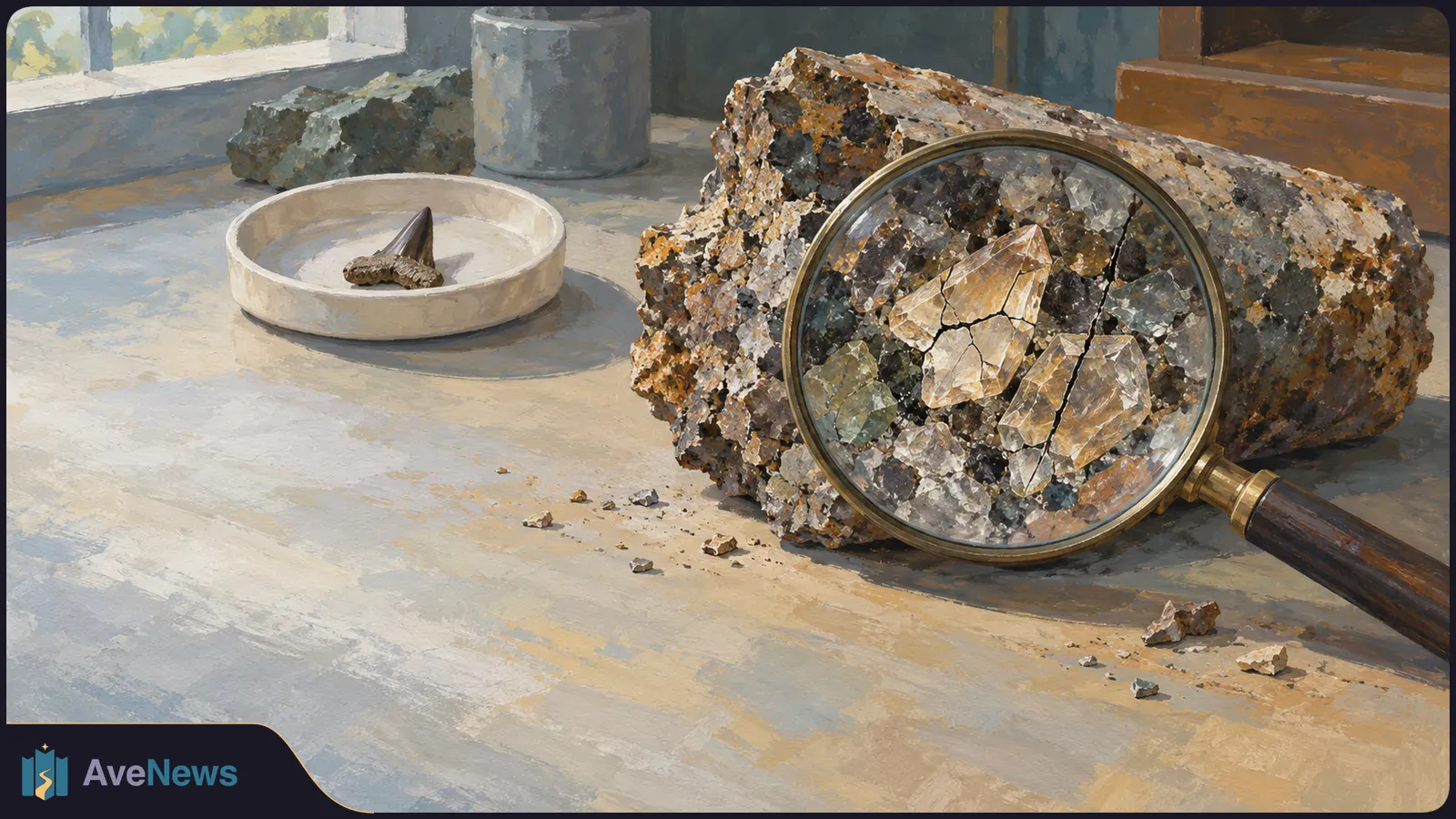
Crystals altered by the collision point to a Late Devonian impact, rather than the older date inferred from fossil teeth.
Crystals altered by the collision point to a Late Devonian impact, rather than the older date inferred from fossil teeth.
The meteorite impact beneath Ames, Oklahoma, occurred about 370 million years ago, according to a University of Texas at Austin study published in July in Meteoritics & Planetary Science. ScienceDaily reports that dating zircon crystals from granite altered by the collision makes the crater nearly 100 million years younger than previously thought.
The revised date places Ames in the Late Devonian period and removes it from the Ordovician Meteor Event, a cluster of much older impacts across North America. The key difference is what the evidence dates: ancient organisms preserved as fossils, or changes in crystals linked to the collision itself.
Before this study, researchers had dated Ames only through biological evidence. Teeth preserved in the rock belonged to conodonts, ancient eel-like animals that lived during the Ordovician period. Those fossils supplied the basis for assigning the impact to that older period.
Lead author Elizabeth Catlos said the teeth were probably already millions of years old when the asteroid struck. Her explanation is that the impact likely churned up older material and mixed the fossils into the impact rocks without destroying them. In that case, the fossils indicate when the animals lived, not when the crater formed.
The team instead used zircon U-Pb, or uranium–lead, dating to determine the age of crystals taken from impact-altered granite. But dating a crystal alone is not enough to connect its age to a collision: researchers also needed to establish that the impact had changed it.
Working with NASA, the team examined the zircons using two imaging techniques, cathodoluminescence and electron backscatter diffraction. The extreme conditions of an impact can cause distinctive recrystallization—changes in a crystal’s structure. The images revealed those changes, allowing the researchers to confirm that the crystals recorded the collision itself.
| Event or estimate | Approximate age |
|---|---|
| Ordovician Meteor Event, to which Ames was previously assigned | 467.5 million years |
| Frasnian–Famennian mass extinction | 372 million years |
| Revised Ames impact estimate | 370 million years |
The revised age puts Ames close in time to the Frasnian–Famennian mass extinction, which eliminated a large proportion of marine life. That chronological proximity does not establish that the impact caused the extinction.
Catlos said more precise dates are essential to understanding whether major extinctions were driven by impacts from space or processes within Earth, including massive volcanic activity. For Ames, the immediate consequence is a different place in that investigation: the revised date excludes it from the Ordovician impact cluster, without settling its relationship to the later extinction.

UCLA Health researchers studied scans from nearly 1,500 adults across three groups. The findings describe associations, not proof of faster biological aging or a gut-driven cause.
3 min
Simulations explore how hypothetical fields from the early universe could change an expansion estimate based on the Big Bang’s afterglow.
Researchers tested a way to improve the framework around an SI agent without retraining its model. Their method limits changes that help familiar tests but fail to carry over to new tasks.
4 min
4 min