
Astronaut heart study tracks early declines and later recovery
Repeated measurements during long space-station missions found a return toward preflight heart measures among exercising astronauts. The findings do not prove exercise caused recovery or guarantee readiness for Mars.
Astronauts who exercised during missions lasting at least six months showed early declines in heart volume and the volume of blood their hearts pumped, followed by a return close to their preflight cardiac baseline. Universe Today reported the findings on October 1, 2026. The pattern addresses a concern for journeys to Mars: whether months in weightlessness leave the heart less able to cope when gravity returns.
The study, published in Circulation, was co-led by Benjamin Levine of the University of Texas Southwestern Medical Center. It followed changes during spaceflight rather than relying only on examinations before departure and after return.
On Earth, the heart works against gravity to send blood toward the brain and upper body. In microgravity—the near-weightless conditions of spaceflight—blood shifts toward the upper body more easily. That reduces the heart’s workload, and over time the heart can adapt by pumping less forcefully and becoming smaller.
A smaller heart can leave astronauts vulnerable when they return to a planetary surface. The concern includes low blood pressure, reduced stamina and fainting. Difficulty tolerating an upright position is called orthostatic intolerance. For a Mars crew, those problems could interfere with work immediately after arrival, following a journey expected to last six to nine months.
According to Universe Today, the paper followed 13 astronauts—nine men and four women—but the accompanying press release gave a total of 14. Each astronaut spent at least six months in space and underwent five monitoring sessions during the mission.

The astronauts used echocardiography, an ultrasound technique that images the heart, on themselves. Researchers tracked heart volume, blood flow and heart-muscle strain—how much the muscle changes shape as it beats. These repeated measurements let the researchers follow the early decline and later recovery during the same missions.
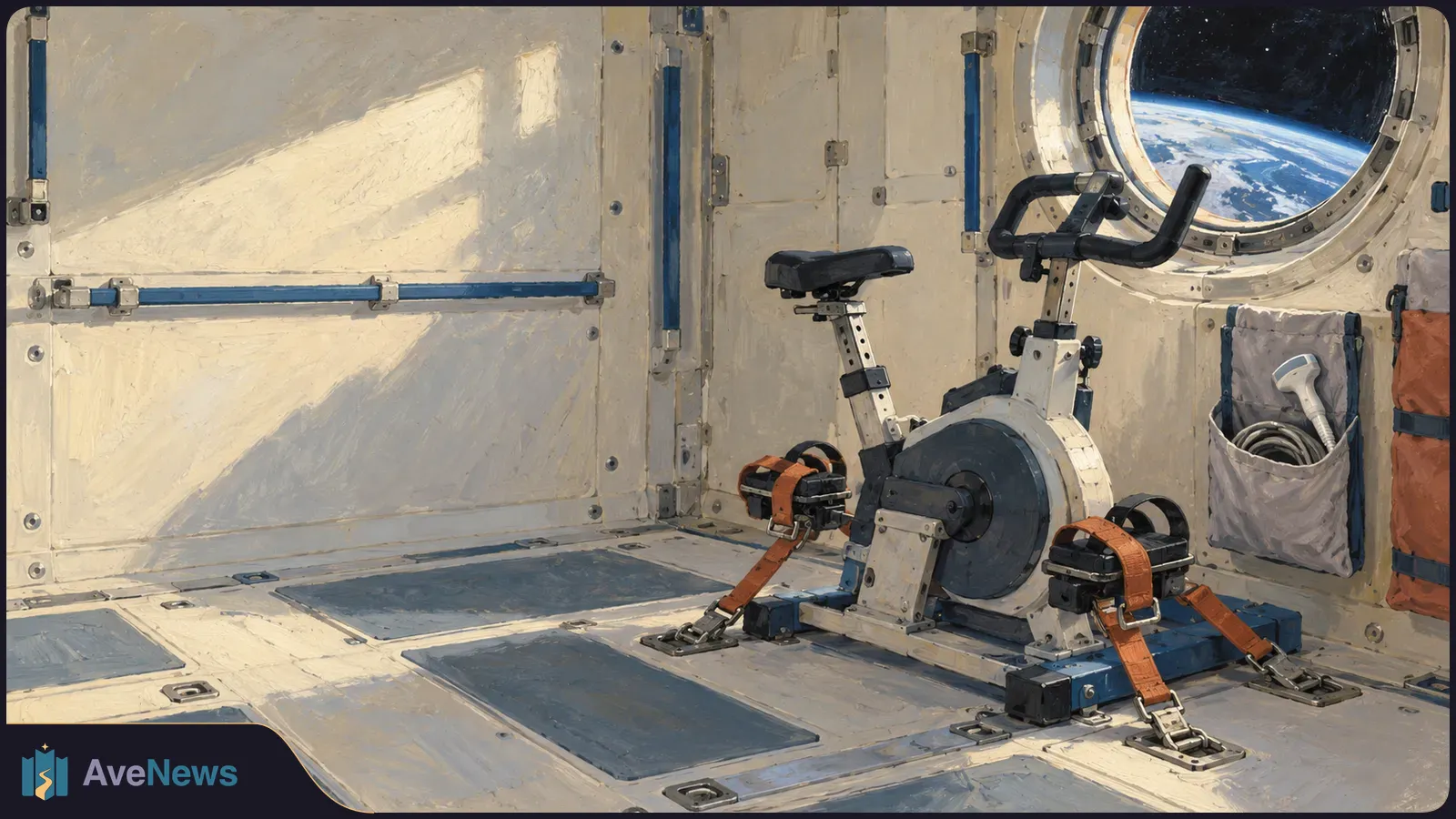
The astronauts performed around two hours of vigorous exercise each day on the International Space Station (ISS). Their routines included cardiovascular exercise to train the heart and circulation, and resistance training to work muscles against a load. Researchers attributed the early declines partly to microgravity and less consistent exercise while astronauts adjusted to mission demands. As exercise became more regular, heart measures moved back toward baseline.
Researchers also assessed cardiac responses while astronauts lay on a table tilted at 22 degrees. The assessment was described as approximating the gravitational load on the heart on Mars.
Analysis
This was a small, exploratory observational study: researchers followed astronauts over time rather than testing exercise against an untreated group. Without that comparison, the recovery among exercising astronauts does not establish that exercise caused it.
Universe Today interpreted the results as support for astronauts being able to work on Mars after arrival, provided they maintain their exercise routine. That is an extrapolation from ISS observations and a tilt-table assessment, not a demonstrated guarantee of safe Mars landings. The measured cardiac recovery addresses one part of mission readiness; other hazards, including deep-space radiation and vision problems, remain.
A separate 7% of people renewing coverage under the rules lost their insurance. Most denials and losses followed unanswered verification requests.
3 min

The French nonprofit wants EU funding to remove these vessels from fishing. An industry association argues that large boats can be efficient and sustainable.
3 min

Researchers compared 2019 posts with deforestation records, estimating a link with up to 420,000 acres cleared. The association does not prove that the messages caused the clearing.
2 min
House style applied: Armenian punctuation, date and money forms.
Correction ·
Corrected spelling and punctuation in the Armenian text.
