
Missing medicines drove a diaspora Armenian back to the US, Hetq reports
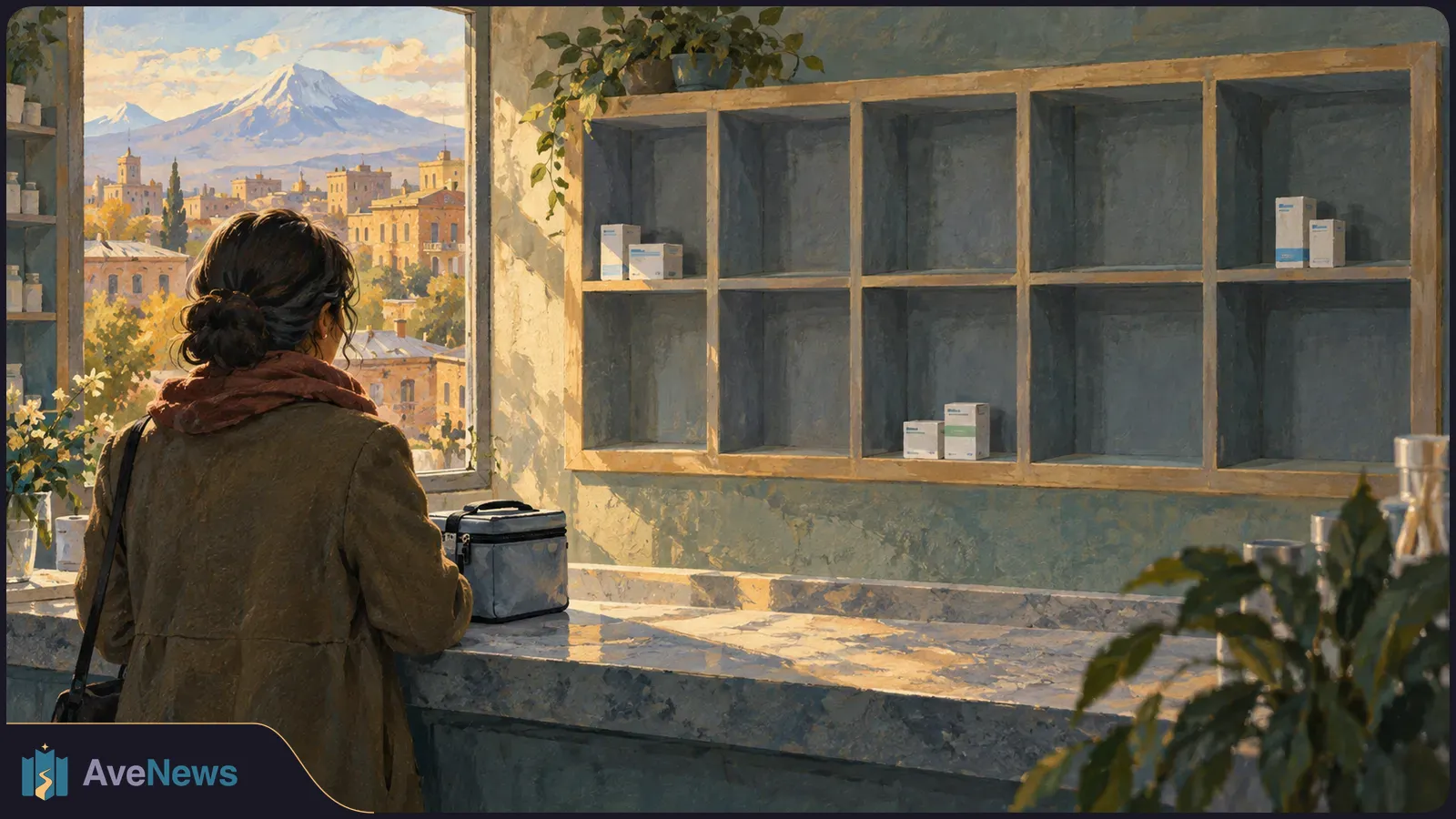
Lily Grigoryan moved from the US to Armenia in 2024 and planned to stay. She told Hetq she went back because Armenian pharmacies could not reliably supply medicines for her autoimmune diseases. Of the 10 medicines she needs, only three were easy to find.
In 2024, Lily Grigoryan, a diaspora Armenian from the United States, moved to Armenia and planned to settle there for good. Her plan included volunteering with Birthright Armenia to build professional contacts in healthcare, her field. Then she was diagnosed with two autoimmune diseases, rheumatoid arthritis and Sjogren's syndrome. In these conditions, the immune system attacks the body's own tissues. The diagnosis ended her plan, and she returned to the US for medical care, Hetq reported in a story by intern Anton Geissler.
Grigoryan told Hetq she gave up on living in Armenia because essential drugs were unavailable or hard to find. She says that without her medicines she cannot walk or talk.
By Grigoryan's account, only three of the 10 medicines she needs to live normally are easy to get in Armenia. Two of them, metformin and spironolactone, are sold widely in pharmacies. They are also covered by the government's new Universal Health Insurance program.
Hetq says some other medicines are hard to find in Armenia even though the World Health Organization and the Armenian Medical Products Regulatory Authority classify them as essential. Plaquenil and clonazepam are on the Universal Health Insurance list. However, Hetq says the program's website offers no evidence that either drug is actually stocked. Grigoryan says doctors sometimes prescribe them, but they are not readily available.
She told Hetq that during her time in Yerevan in 2026 she found only one pharmacy that sold dutasteride. It cost AMD 20,000, and she was unsure whether it was genuine or counterfeit.
Hetq says five more drugs are not registered or stocked in Armenia: Enbrel, finasteride, oral minoxidil, Trintellix and Adderall. In most countries, a medicine must be registered with the national regulator before it can be sold legally. The report does not include registration records from the regulator.

Hetq has reported before that some of these drugs are brought into Armenia illegally and sold on the black market. Grigoryan says that was not an option for her. Many of her medicines are injections that must be kept at specific temperatures. She also considered travelling to Greece or Georgia every month or having prescriptions mailed from the US. She decided against both because they were not reliable.
Analysis
Hetq says many of these medicines are unavailable because of cost. The outlet has reported before that many drug importers see Armenia's small market as unprofitable.
Grigoryan offers another reason for two of the drugs. Trintellix treats depression, and Adderall treats ADHD. She believes they are not registered because of stigma around mental health in Armenia. That is her view, and the report does not establish it as the cause. Hetq also notes that Adderall is a controlled substance, so possessing it is illegal. “I think that Armenia’s attitude towards mental health causes a lot of people to suffer,” she told Hetq.
The story rests on one patient's experience. It gives no response from Armenia's medicines regulator or the Universal Health Insurance program. It also offers no official data on which drugs are registered or how often pharmacies have them in stock. So it cannot show how common her problems are among patients in Armenia or among diaspora Armenians who move there.
Grigoryan has not given up. She told Hetq that she and a friend with similar conditions are looking at ways to return to Armenia. “I think that there are a lot of diasporans whose dream is to go back,” she said. “It is a sad reality to accept that the one thing that is holding me back from my dream is that Armenia does not have the healthcare I need.”
The four astronauts returned after a delayed crew change at the International Space Station.
5 min

The holographic principle says that everything inside a region of space might be fully described by information on its surface. A Quanta Magazine essay separates the math behind the idea from open questions about whether it applies to our universe.
7 min

On 28 September, ESA's Juice spacecraft passed 8,640 km above the Indian Ocean. Earth's gravity changed its direction by 20° and increased its speed by 3.5 km/s. Mission teams also used the pass to test its instruments and to study Earth's magnetic field.
4 min
