
Wild blacktip sharks detected sound up to 74 metres away
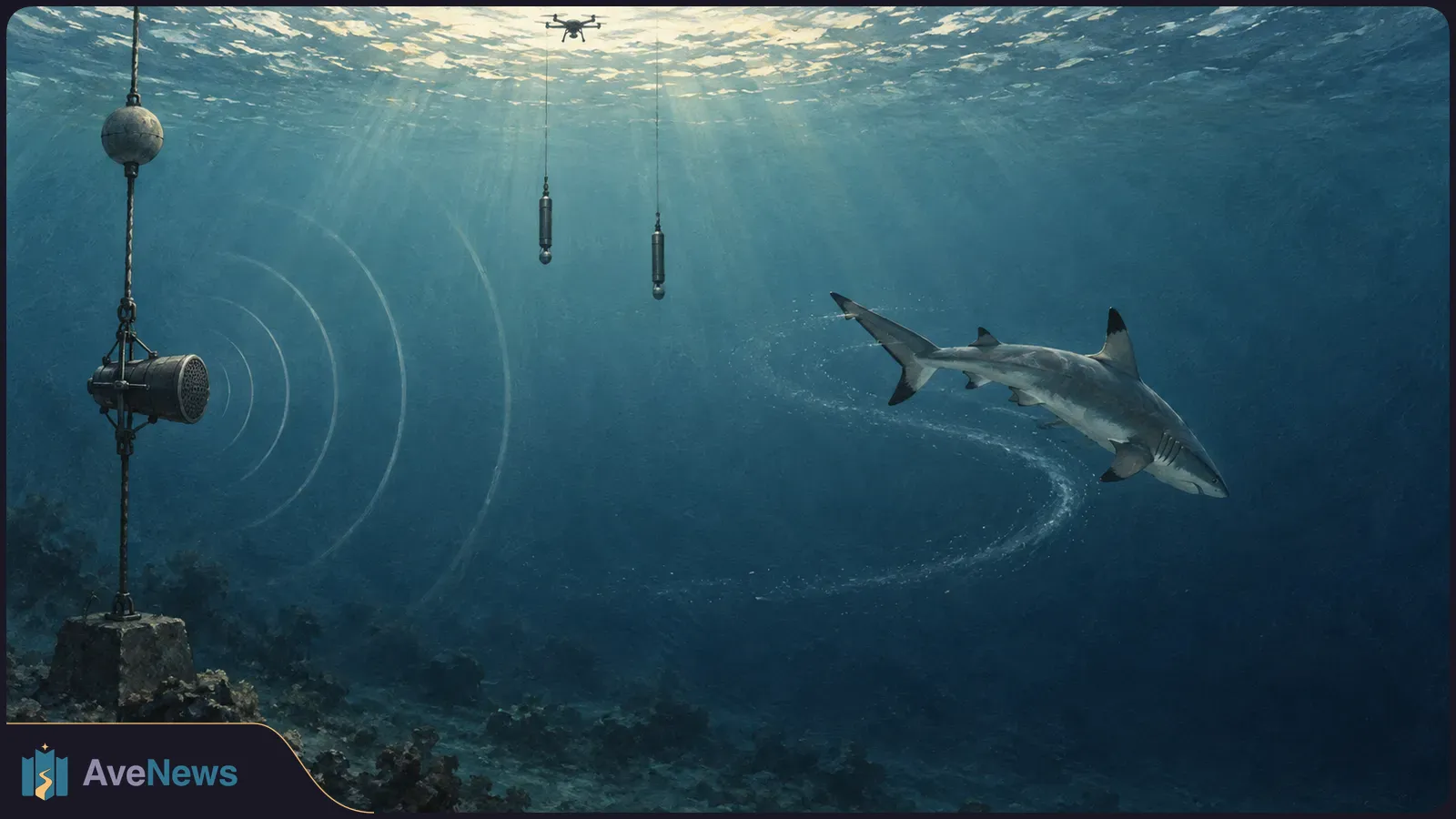
An ocean experiment recorded rapid turns away from low-frequency sounds, offering evidence of direction sensing without proving a reliable shark deterrent.
Wild blacktip sharks detected low-frequency sounds from up to 74 metres (243 feet) away in an ocean experiment by Florida Atlantic University researchers. The animals often turned rapidly away from the underwater speaker, a response the team interpreted as evidence that sharks could determine where the sound came from—not merely notice it. ScienceDaily reported the findings, published in Integrative Organismal Biology.
More than 70% of the recorded responses occurred in the acoustic far field: beyond the region close to a sound source where sound behaves differently. ScienceDaily described the study as the first quantified evidence of freely swimming sharks detecting and turning away from sounds in this region.
The team worked in shallow coastal waters in Palm Beach County, Florida, where blacktip sharks gather predictably and clear water makes them visible from above. Researchers anchored a boat and allowed an underwater speaker to drift with the current up to 19 metres from the vessel, reducing the possibility that the boat itself would influence the sharks.
The speaker played three low-frequency bands: 100–200, 200–400 and 400–800 hertz. Hertz measures the number of sound vibrations per second. Sharks responded to all three bands but showed no response to a 10-kilohertz, or 10,000-hertz, control sound outside their known hearing range. They were most sensitive to the lower frequencies, responding at greater distances and lower sound levels.
A drone flying 40–50 metres above the water recorded shark movements during both the experimental and control sounds. Frame-by-frame analysis measured each shark’s distance from the speaker and how sharply it changed direction. Calibrated underwater microphones, called hydrophones, measured sound levels at different locations, allowing the team to determine the sound level where each shark reacted.

Testing in the ocean also avoided a problem with laboratory tanks: sound repeatedly reflects from tank walls, creating complicated patterns that make an animal’s response harder to interpret. Lead author Caroline Sullivan said ocean experiments allow researchers to observe natural responses from wild sharks.
The researchers deliberately played sounds loud enough to provoke a startle response, rather than trying to attract sharks to the speaker. Turning away during these tests does not establish that sound is a reliable shark deterrent.
The observed turns also do not settle how sharks sense distant sound. Sharks lack the gas-filled swim bladder that helps many bony fish detect sound pressure. Instead, sharks are believed to rely largely on their inner ears, including sensory structures that may detect sound-related motion and vibrations.
Senior author Stephen Kajiura suggested that the distant responses reflect detection of particle motion—the movement of water particles associated with sound. That is a proposed explanation for the behaviour, not a mechanism demonstrated by the experiment. The researchers’ next question is how the shark sensory system detects and processes these distant signals.
Brain-age estimates differed across conditions and brain regions, but the findings do not show that the disorders cause faster aging.
2 min

A two-year study found different patterns depending on mothers’ depression history. Whether those patterns relate to later depression diagnoses remains under study.
2 min

A second neural network helps the SI search ahead despite concealed pieces. Ars Technica reports training costs of a few thousand dollars, far below the researchers’ estimate for DeepNash.
3 min