Loading… Բեռնվում է…
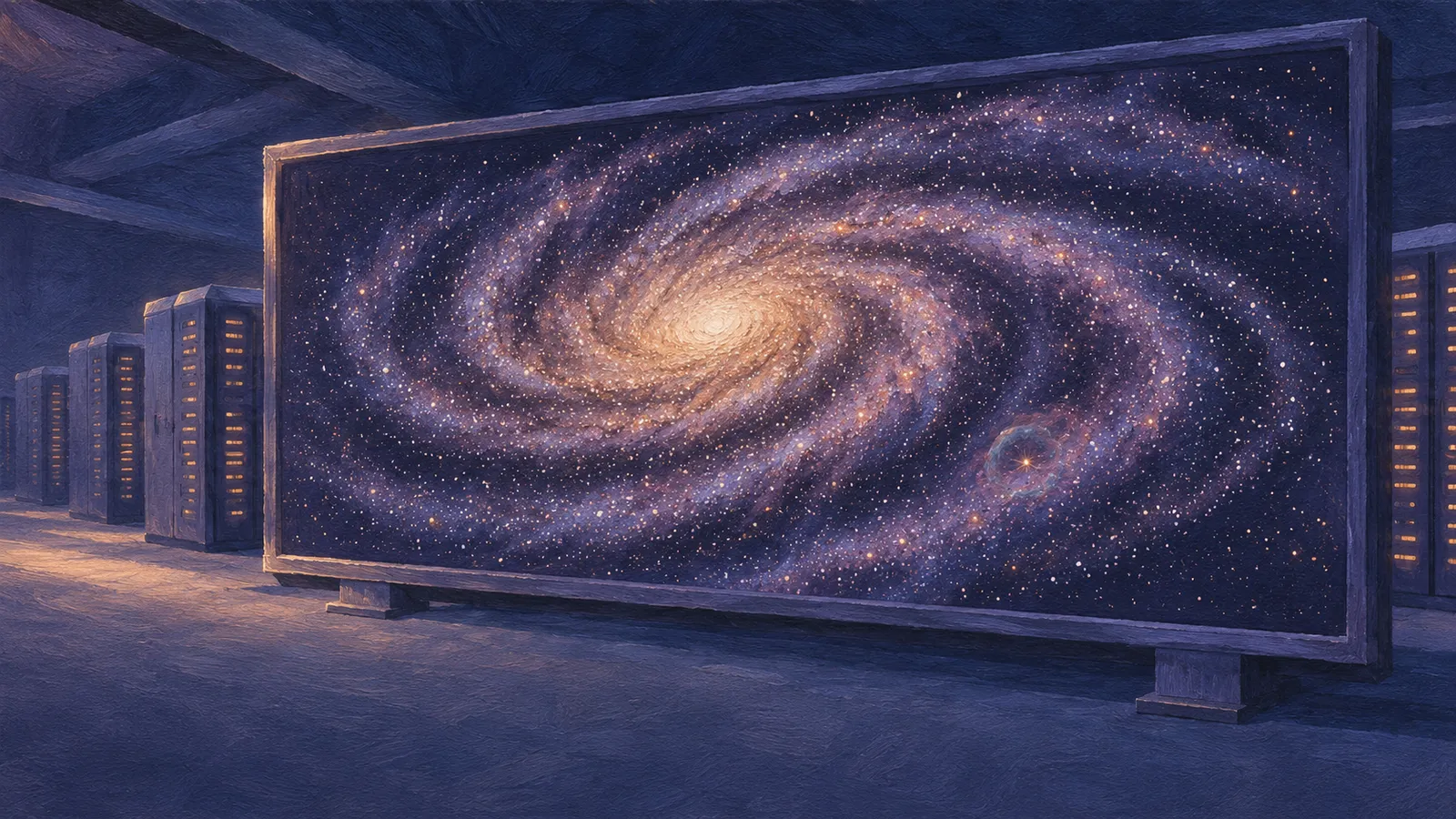
The team says its largest PHEASANT run used 5.4 trillion particles, about 10,000 times as many as the advanced simulations it used for comparison, giving astronomers a way to study stellar events across a galaxy-scale model.
Researchers presented PHEASANT, a simulation of a Milky Way–scale galaxy that represents individual stars, at the SC 2026 supercomputing conference in Chicago. It models a galaxy; it does not map the real Milky Way’s individual stars.
The researchers say their largest run used 5.4 trillion particles, approximately 10,000 times as many as the advanced simulations they used for comparison. In an earlier account, researcher Keiya Hirashima said conventional simulations commonly grouped about 1,000 stars into a single point to reduce the computing load.
A model developed by Hirashima, a postdoctoral researcher at RIKEN, predicts how gas around exploding stars changes. The team says that shortcut and adaptations for different supercomputers make it possible to study the effects of individual stars across a galaxy.
A supernova heats surrounding gas and pushes it outward. Dense gas can change rapidly, so calculating its behavior directly requires many short steps. Hirashima said those steps are roughly 100 years long, while his superintelligence (SI) model predicts the gas distribution after 100,000 years.
The researchers say this makes the simulation around 20 times faster than calculating the same supernova-related process directly. The prediction lets the larger galaxy simulation skip many of the smaller steps, Phys.org said.
Hirashima said an earlier simulation using the predictive model ran on the Fugaku supercomputer with 300 billion particles representing stars and interstellar gas. It demonstrated that star-by-star resolution was feasible before the team moved toward systems centered on graphics processors, or GPUs.
The team optimized PHEASANT for Aurora, Frontier and JUPITER, which use different combinations of processors and GPUs. The researchers measured how many particles the code processed per second on each system; those measurements are separate from the comparison of supernova calculation methods.
| Supercomputer | Particles processed per second |
|---|---|
| Aurora | 144 billion |
| Frontier | 101 billion |
| JUPITER | 135 billion |
The conference paper reports performance across Intel, AMD and NVIDIA GPUs.
Analysis
The team says the model produced a star-formation rate similar to estimates based on observations of the real Milky Way. University of Tokyo astronomy professor Michiko Fujii said the simulation can help researchers investigate how individual supernovae affect star formation, giant gas bubbles and material flowing out of a galaxy.
We can also study how groups of stars form and how they may eventually develop into star clusters.
 phys.org Space
Hirashima also wants to trace how material circulates between the galaxy’s disk and surrounding halo, and how spiral arms relate to the formation of molecular clouds, where stars are born. He said the team has not yet simulated the full formation of a galaxy like the Milky Way and identified understanding that history as a next step.
The Falcon 9 flight followed the previous launch from the California pad by a record 32 hours, 3 minutes and 21 seconds. Its booster landed nearby after its 14th flight.
2 min

Georgian Dream says it will introduce legislation in Parliament. Majority leader Irakli Kirtskhalia says IVF will remain under strict regulation and available only to Georgian citizens.
3 min

Charles Pascoe Grenfell and William Thompson pursued private mining interests in Cuba after Britain abolished slavery in most of its empire, Chris Evans’s research finds.
3 min

