
Minerals reveal a changing burial path in a Papua New Guinea rock
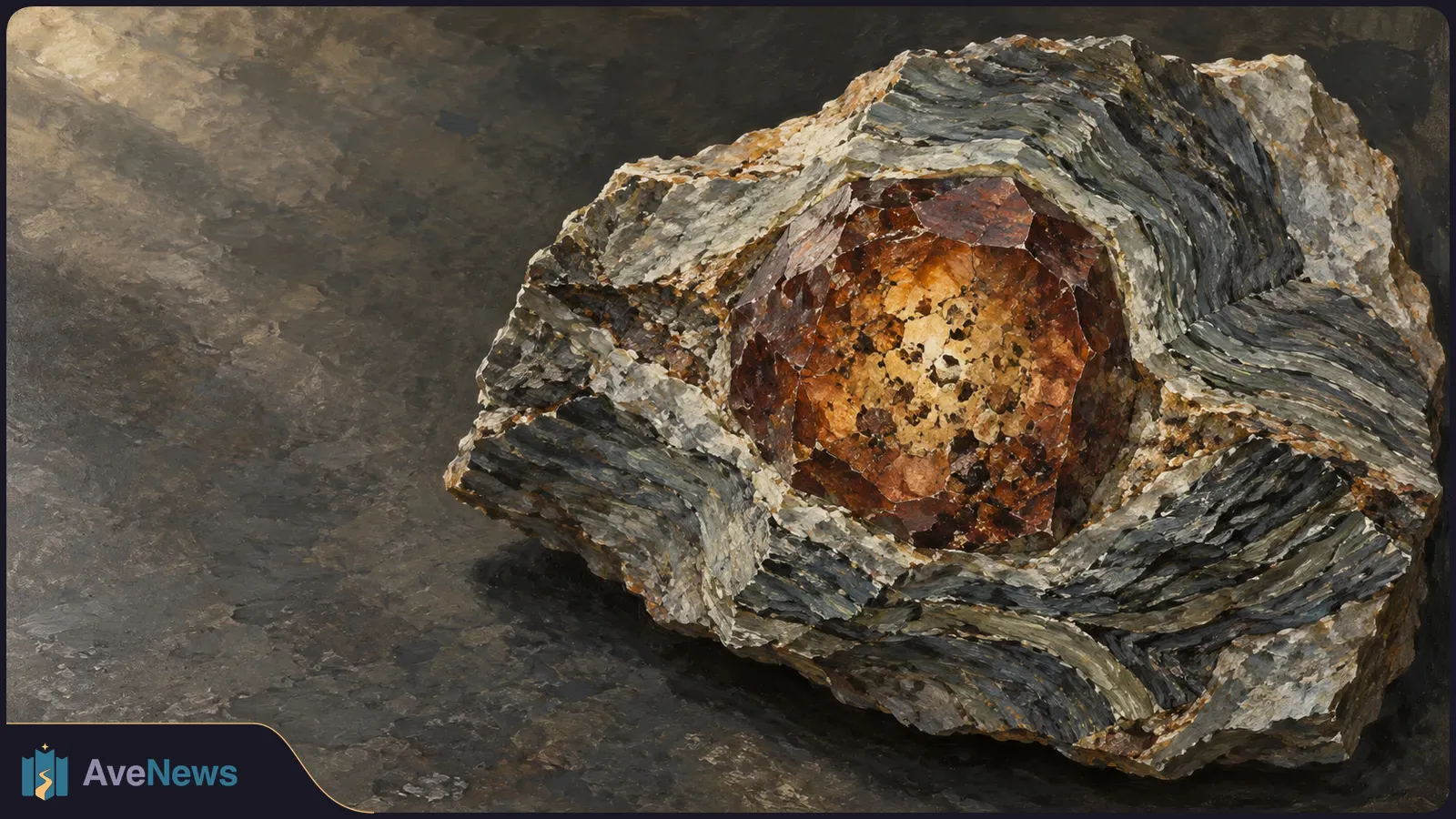
Tiny inclusions in garnet preserve an early warm stage that the rock’s deepest-burial conditions alone would miss.
Tiny inclusions in garnet preserve an early warm stage that the rock’s deepest-burial conditions alone would miss.
A rock from Goodenough Island in eastern Papua New Guinea records an initially warm stage of burial followed by a colder, deeper subduction regime, according to a study published in Nature Geoscience on 1 October 2026. Subduction happens when one tectonic plate descends beneath another. The study shows how minerals trapped inside growing crystals can reveal earlier conditions that the rock’s highest-pressure stage alone would not disclose.
Here, “colder” means a lower temperature relative to pressure—not a fall in the rock’s temperature. The researchers estimate that temperature rose from about 700 °C to 800 °C as the rock descended. Its early path had an apparent average temperature-to-pressure gradient of about 470 °C per gigapascal down to roughly 45 kilometres, before shifting to a lower-gradient regime.
Ultrahigh-pressure metamorphism describes the changes in crustal rocks buried deeper than 90 kilometres, where the mineral coesite is stable, and subsequently brought back toward the surface. Such rocks are widely treated as evidence of cold subduction because their peak conditions show low temperature-to-pressure gradients. But increasing heat and pressure can alter earlier minerals, obscuring the conditions along the way down.
The researchers examined one eclogite—a rock transformed under high pressure—that had partly changed again after its deep-burial stage. Its garnet crystals retain three chemically distinct growth zones: a core, an intermediate zone called the mantle, and an outer rim. Here, “mantle” names part of a crystal, not Earth’s mantle.
Quartz and coesite are forms of the same substance, silica, but coesite is stable at higher pressure. The garnet cores contain quartz but no coesite; coesite inclusions occur only in the intermediate zones. That contrast indicates that successive crystal growth crossed the quartz-to-coesite transition at approximately 2.7–3.0 gigapascals (GPa), a unit of pressure.
Other inclusions are interpreted as tiny melt droplets that crystallized after being trapped during garnet growth. They show that some melting had begun. The team remelted one core inclusion into glass at 750 °C and 2.5 GPa. The authors treat that temperature as an approximate constraint on garnet formation and the experimental pressure as a maximum—not an exact measure of the rock’s burial pressure.
The researchers also used the amount of zirconium in rutile inclusions to estimate temperature, then combined those estimates with the melt experiment and modelling of garnet chemistry. A water-related signal in the remelted glass suggested that water was present during melting, supporting their model’s assumption of water-saturated conditions.
| Growth zone | Pressure | Temperature |
|---|---|---|
| Core | 1.5 ± 0.2 GPa | 700 ± 20 °C |
| Intermediate mantle | Greater than 2.9 GPa | 800 ± 25 °C |
The high-pressure estimate has important limits. Above 1.8 GPa, the modelled garnet composition becomes insensitive to changes in pressure and temperature, so it cannot independently determine the intermediate zone’s formation conditions. The exact temperature at which melting begins is also uncertain at those pressures. Coesite supplies the high-pressure constraint, while rutile supplies the temperature estimate.
To establish timing, the team dissolved garnet and analysed uranium and lead isotopes in 26 tiny zircon inclusions. After excluding analyses with too little lead produced by radioactive decay and those from an inherited crystal, the researchers retained 17 dates. These range from 5.1 ± 0.2 to 3.1 ± 0.1 million years ago. The dating figure reports uncertainties as twice the standard error, a statistical measure of precision.
Because the zircons were analysed after extraction, their dates were linked to garnet growth zones through their chemistry rather than their original positions. Concentrations of heavy rare-earth elements decreased from about 5.1 to 4.4 million years ago. That could reflect growing garnet taking up those elements, removal of an enriched melt, or both. The authors favour garnet growth as the dominant process because garnet was growing while melt was present and preferentially takes up these elements.
The authors interpret the oldest zircon as setting a maximum age for core growth and place the ultrahigh-pressure stage at about 4.4 million years ago. In their reconstruction, burial from no more than 1.5 GPa to greater than 2.9 GPa took about 700,000 years. That implies vertical descent exceeding 60 millimetres per year, assuming lithostatic pressure: pressure caused by the weight of overlying rock.
Analysis
The authors propose two possible explanations: heat generated as rocks shear along the boundary between plates, and the changing thermal structure of a recently initiated subduction zone. Neither is established as the cause of this sample’s history. The relatively narrow zircon age range supports their interpretation of one continuous burial event rather than two separate metamorphic events.
The researchers suggest that warm conditions at shallower depths might be common even in systems that later produce ultrahigh-pressure rocks. This one-sample reconstruction does not establish how widespread that pathway is. It does show why peak-pressure conditions need not describe the earlier thermal history of the same rock.
Brief electrical pulses reduced disruption from moving magnetic flux and heat, revealing contrasting responses in two superconducting materials.
3 min

Responses in 35 volunteers averaged 41 milliseconds faster during exhalation than inhalation. Earlier memory and recognition tests found the opposite pattern.
2 min

Businesses with more than 50 employees face restrictions on promoting certain foods high in fat, sugar or salt. Ordinary discounts and meal-deal offers remain allowed.
2 min
