
Nearly ten-minute X-ray flash points to a neutron-star merger
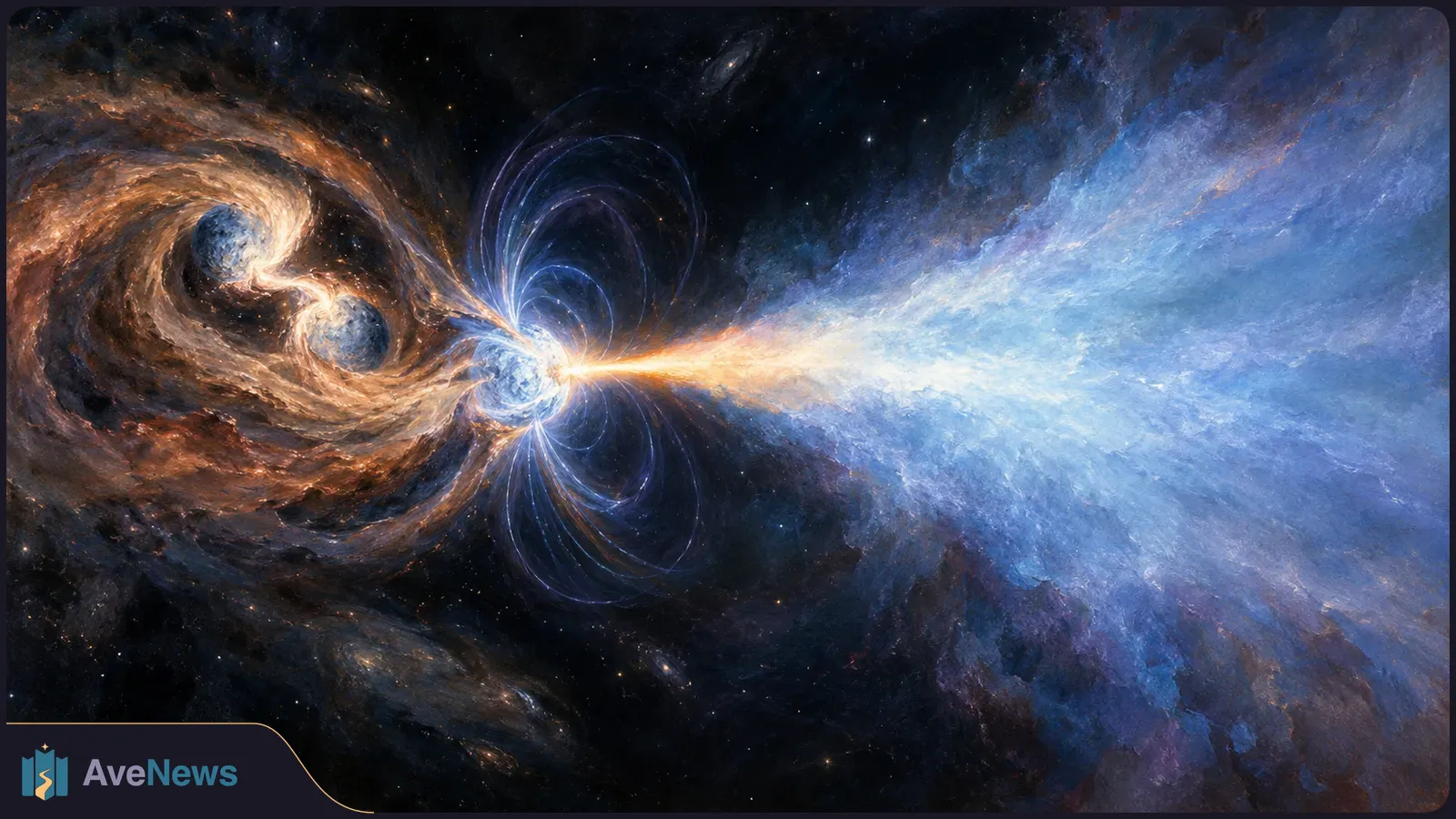
A half-second gamma-ray burst accompanied unusually long X-ray emission. Researchers suggest a newly formed magnetar could explain why the X-rays lasted so long.
Astronomers have found strong evidence that a nearly ten-minute X-ray flash came from two neutron stars merging, according to a study published in Science Bulletin and reported by ScienceDaily. The event, EP250704a/GRB 250704B, was detected on July 4, 2025, by the SVOM, Insight-HXMT and Einstein Probe satellites. Its gamma-ray burst lasted about half a second, but Einstein Probe recorded bright X-rays for nearly ten minutes.
Neutron stars are extremely dense remnants left after massive stars reach the ends of their lives. Astronomers have traditionally identified their mergers through short gamma-ray bursts, which can fade in less than two seconds. If the team's merger interpretation is correct, this event produced the longest-lasting prompt X-ray flash—the emission associated with the initial burst—yet observed from such a collision, according to Niccolò Passaleva, who led the follow-up observations with the Very Large Telescope in Chile.
Rapid follow-up helped the team study the event before it faded. The Very Large Telescope's X-Shooter instrument separated its light into a spectrum, revealing absorption patterns that allowed the researchers to measure its redshift: the shift in light's wavelengths used to estimate cosmic distance. The measured value, z=0.6610, indicates that the light travelled for more than six billion years before reaching Earth.
The team also used the telescope's FORS2 instrument to search for a bright supernova, the stellar explosion normally expected if a long-lasting X-ray flash came from a massive star's collapse. No supernova appeared in those observations. The researchers say the measured distance, the lack of a supernova and the burst's properties together provide strong evidence for a neutron-star merger, rather than an established identification.

Planned parachute and emergency-rescue tests would examine key safety systems, but the hardware’s flight readiness and a 2028–29 crewed-launch target remain uncertain.
Analysis
The researchers suggest the collision may have formed a magnetar. Study co-corresponding author Eleonora Troja describes magnetars as rapidly spinning neutron stars with enormous magnetic fields. If a merger leaves such a remnant, she says, its magnetic energy could make the explosion brighter and keep the emission going for longer. That offers a possible explanation for the unusually long X-ray flash.
The finding could also help explain some fast X-ray transients—brief, bright X-ray flashes whose origins are not always known. Einstein Probe has detected hundreds since its January 2024 launch. Some have been linked to massive-star deaths; the new study suggests neutron-star mergers could account for some others, not all of them.
More events like this one could help astronomers determine how often neutron-star mergers form magnetars. These collisions also generate gravitational waves that travel through space. Passaleva hopes a future observing run will capture an X-ray flash and gravitational waves from the same source, linking the two signals directly.
2 min

Across 63 studies, cannabis use was associated with committing and experiencing violence. The findings do not prove cannabis causes either.
2 min

The two-year programme with Croatia and Slovenia focuses on financing, rules and administration. It supports the reform rather than adding a new entitlement.
3 min