
RNA forms droplets more readily than similar DNA in lab tests
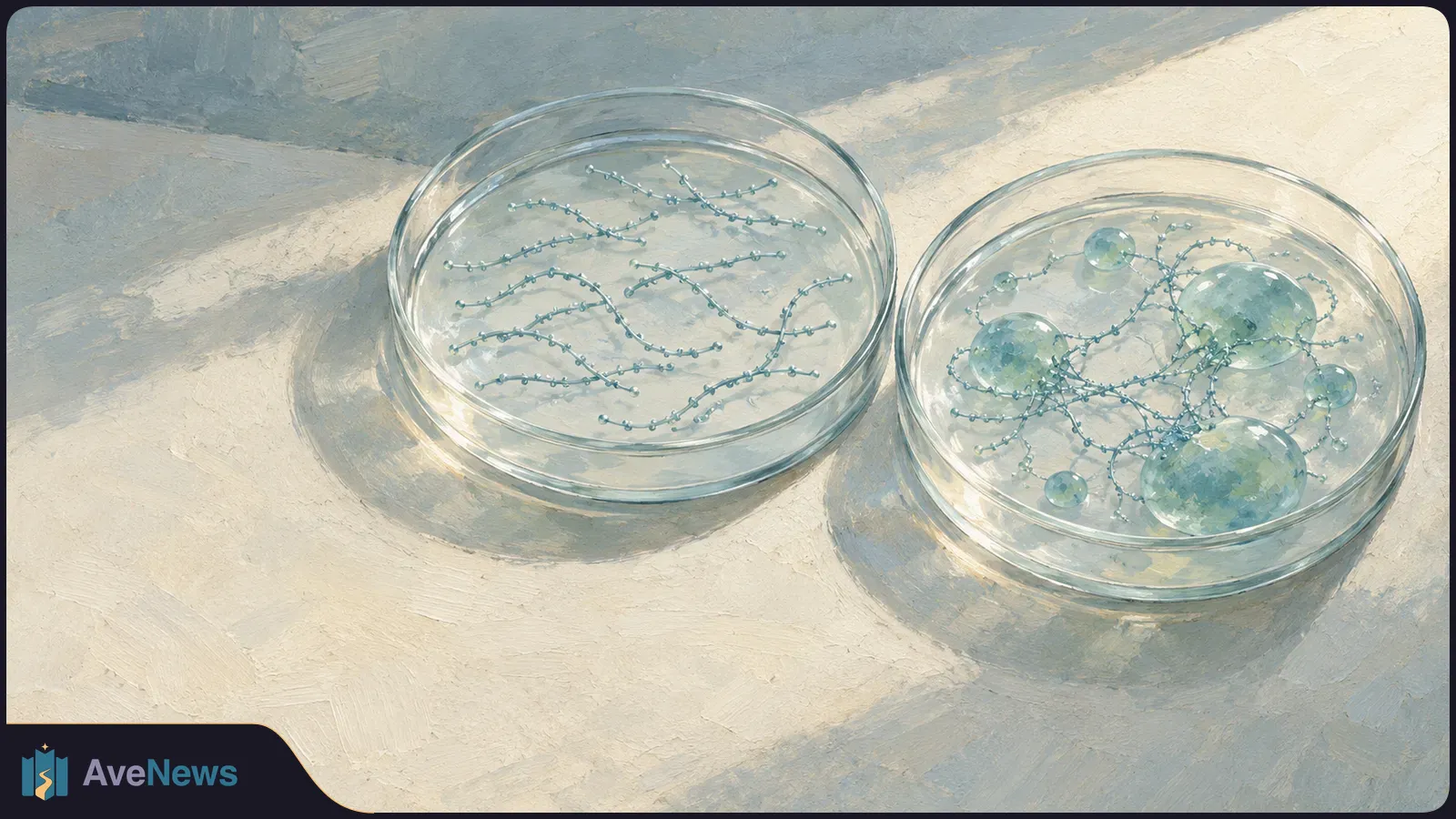
A University at Buffalo-led study points to a small chemical group on RNA’s sugar as a reason for the difference. Whether these droplets helped life emerge remains an open question.
A University at Buffalo-led study points to a small chemical group on RNA’s sugar as a reason for the difference. Whether these droplets helped life emerge remains an open question.
RNA began forming droplets at temperatures about 10°C lower than single-stranded DNA containing essentially the same sequences, ScienceDaily reported on October 2. RNA also more readily formed connected networks inside the droplets, turning them from fluid into more gel-like material. The University at Buffalo-led study was published in Nature Communications under the journal’s early-access guidelines.
These liquid-like droplets, called condensates, have no surrounding membrane but can concentrate RNA molecules in one place. A 2023 study led by University at Buffalo physicist Priya R. Banerjee found that RNA could organize into droplets at high temperatures. The later comparison with similar DNA sequences helped the researchers investigate which chemical feature makes RNA more prone to gather this way.
Each RNA sugar contains a 2′-hydroxyl group, written as 2′-OH, which DNA sugars lack. A hydroxyl group contains oxygen and hydrogen; the 2′ identifies its position on the sugar. This small difference became the focus of the experiments.
The team used temperature-controlled microscopy to observe the material as temperature changed, and small-angle X-ray scattering to investigate its structure. Molecular dynamics simulations—computer models of molecular movement—were performed by collaborator Jerelle Joseph’s group at Princeton University.
The researchers propose that the 2′-OH strengthens RNA’s interactions with magnesium ions, which are electrically charged atoms. Their results also suggest that RNA holds fewer water molecules around its backbone than DNA. Together, they suggest, these differences make it easier for RNA molecules to approach one another and assemble as temperatures rise.
To test the group’s importance, the researchers chemically changed the 2′-OH to a modified form called 2′-Ome. The change reduced RNA’s tendency to form condensates and altered whether the resulting structures stayed fluid or became gel-like. That experiment supports a role for the sugar group in controlling both droplet formation and the material’s behavior.
RNA world theory proposes that RNA played a central role in life’s emergence because it can both store genetic information and help drive chemical reactions. But RNA is relatively unstable. How it survived conditions before life existed, and how enough molecules gathered to interact before cell membranes arose, remain unresolved questions.
Droplets offer a possible way to concentrate RNA without membranes. Becoming gel-like might also have helped protect it under difficult conditions. Banerjee presents a connection to early life as a possibility, not an established historical finding: the laboratory observations do not show whether such compartments actually helped life emerge.
ScienceDaily also reported that Banerjee’s laboratory was working to engineer RNA droplets capable of basic cell-like activities, including biochemical reactions. The aim is to create active, cell-sized compartments; those capabilities remain a research goal rather than a demonstrated outcome of this study.

The proposal would shorten the adult questionnaire from 482 questions to 150. HHS cites lower collection costs, while researchers warn that the cuts would worsen gaps in disability data.
2 min

The Alabama plant operates legally under an expired permit. Environmental groups say delays hold up residents’ ability to challenge a proposed renewal.
3 min

Las Vegas is already drawing water through a deeper reservoir intake, while Phoenix is building a facility to turn used water into drinking water.
5 min