
Rubin data reveal 2 more trailing Neptune Trojans and 1 candidate
The trailing cloud had appeared against the Milky Way’s crowded stars for 15 years. Researchers found the objects in telescope-testing images, expanding the sample available to study the early solar system.

In this article
Researchers examining images from the Vera C. Rubin Observatory in Chile identified 2 additional trailing Neptune Trojans and 1 further candidate, Science News said. These icy bodies share Neptune’s orbit around the sun.
Neptune Trojans follow roughly the planet’s orbital path and take about as long to circle the sun, clustering near regions called L4 and L5, 60 degrees ahead of and behind Neptune, respectively.
Before these discoveries, astronomers had found far fewer objects in the trailing group than in the leading group.
| Group | Known objects |
|---|---|
| Leading Neptune | 30 |
| Trailing Neptune | 2 |
Finding objects against a crowded sky
Viewed from Earth, the trailing cloud had appeared against the Milky Way for 15 years. Its dense background of stars made individual Trojans difficult to distinguish.
Planetary scientist Meg Schwamb of Queens University Belfast and her colleagues found the objects in Rubin’s commissioning images, taken while engineers were testing the telescope. Schwamb said the objects happened to fall within the area covered by those observations.
Rubin took its first images in June 2025 and officially began its 10-year survey in June 2026. The observatory aims to map the entire southern sky every couple of nights, searching for faint and moving objects.
Schwamb discussed the discoveries at a news conference on 28 October 2026 during the American Astronomical Society’s Division of Planetary Sciences meeting in Spokane, Washington. The findings also appeared in Astrophysical Journal Letters.
Clues to the solar system’s beginnings
Astronomers think Neptune Trojans may be original building blocks of the solar system, preserving evidence of how planets formed and evolved. The newly found trailing objects appear similar in composition to the leading ones, a resemblance consistent with formation theories.
Neptune Trojans' observed colors can be compatible with many different surface compositions. Color resemblance alone therefore cannot establish that two objects have the same surface materials.
The Nice model proposes that the giant planets moved from a compact arrangement to their present positions; one proposed origin for Neptune Trojans is capture as the planets changed orbits, rather than formation in their current locations or through collisions.
Schwamb said researchers expect the leading and trailing groups to contain similar numbers of objects. She expects Rubin’s survey to find hundreds more Neptune Trojans, giving astronomers a larger sample to study.
Earlier in Science
 Space
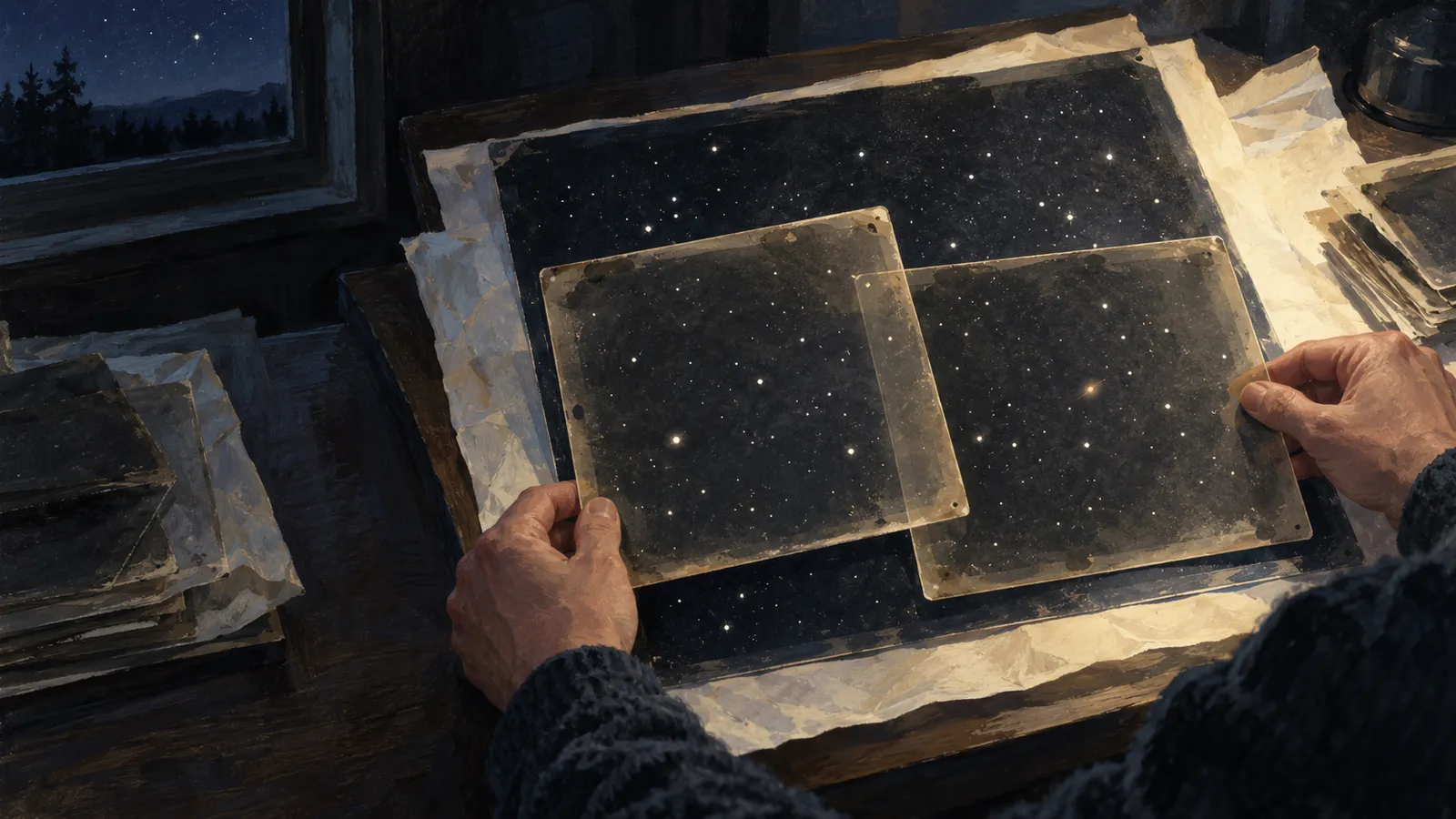
Amateur astronomer Sam Deen says he found 2026 ED138 in two 1954 images
Sam Deen’s finds extend the candidate’s record 62 years before the 2016 sightings, providing about 72 years of positions for orbit calculations. Other amateurs independently found the same Palomar sightings.
3 min
 Earth
Syrian Civil Defense rescues 15 as floods kill at least 5
5 people, including 2 children, remain missing. State news agency SANA says al-Salmani Bridge collapsed west of Tabqa, closing the Raqqa–Aleppo road.
2 min
 Earth
Wildlife trusts complete 9,500-acre Rothbury Estate purchase
The Wildlife Trusts and Northumberland Wildlife Trust say a low-interest loan bridged the gap while pledged funds awaited payment, allowing them to complete the acquisition.
4 min


