
‘Tangles’ rethinks movement with longer drawing holds
At SCAD AnimationFest, artists explained how drawing timing and cinematic references shaped their work on ‘Tangles,’ ‘Forgotten Island’ and ‘Ray Gunn.’
At SCAD AnimationFest, artists explained how drawing timing and cinematic references shaped their work on ‘Tangles,’ ‘Forgotten Island’ and ‘Ray Gunn.’
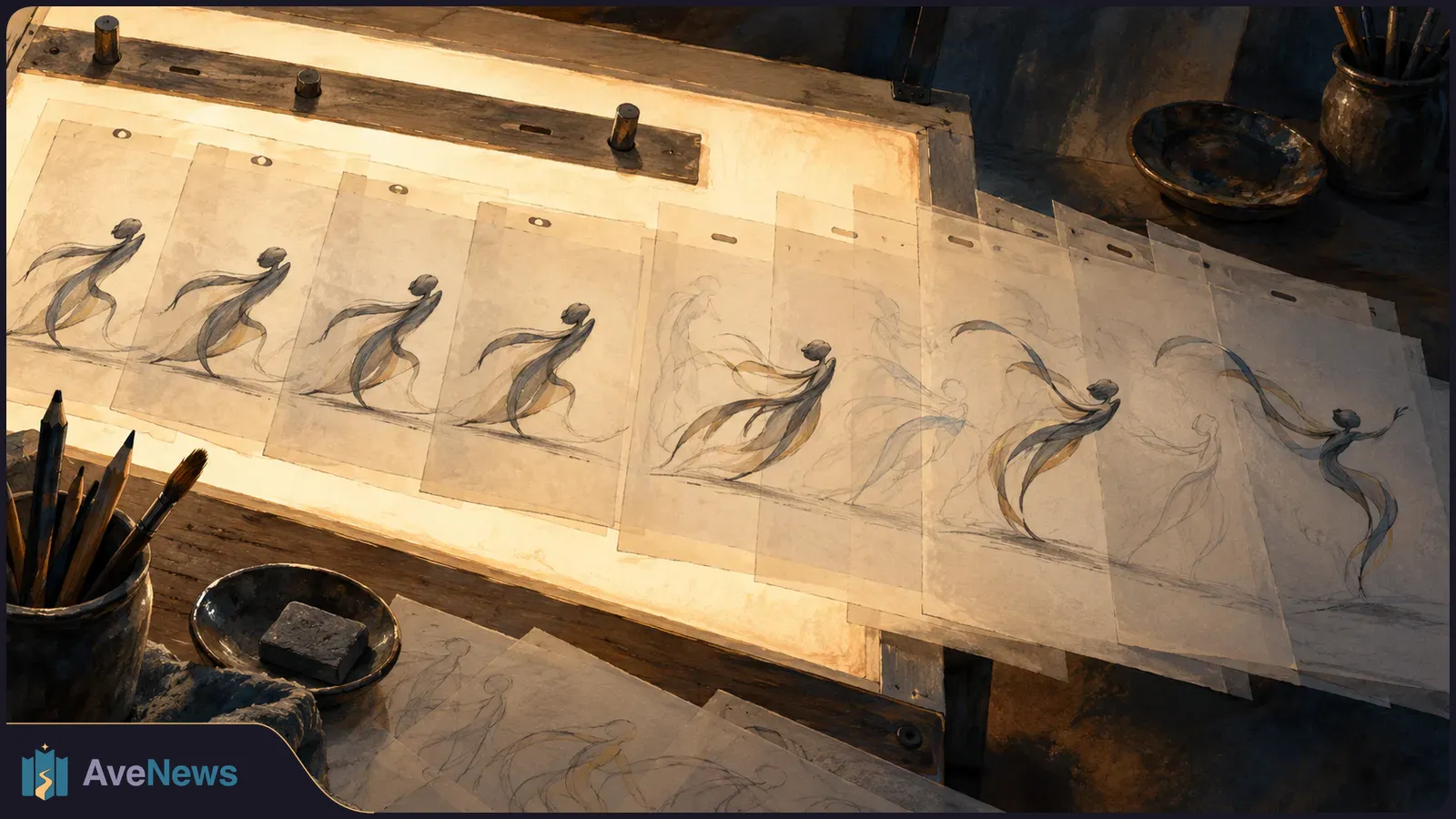
On the hand-drawn feature “Tangles,” animation director Eric Bofa Nfon moved his animators from drawings held for two frames to holds of three or four, with one sequence using eight. The change required rethinking movement, not simply stretching out the same drawings, he explained at the 10th annual SCAD AnimationFest in Atlanta. Variety reported on the discussion, which it moderated, on October 1.
Frames are the individual images in a film’s sequence. Animating “on twos” means keeping a drawing for two consecutive frames before changing it; “threes,” “fours” and “eights” extend that hold. Variety described twos as the industry standard. Longer holds meant fewer drawings for the independent production and gave the animation a different visual texture, but the decision was not merely about the budget.
You don’t just take twos and push them into threes or fours. You have to think about the motion and where to select your drawings.
His explanation makes the distinction important: changing the drawing rhythm also changes the choices an animator must make about how to show motion. A longer hold is not just the same animation played more slowly.
For Maarten Lemmens, lead animator on DreamWorks Animation’s “Forgotten Island,” the challenge was learning a different visual language. The directors sent anime films—Japanese animation—to the crew. Lemmens recalled that he had watched little anime, so he spent his Christmas break studying it. He said he eventually became one of the film’s anime specialists because he was among the few who had done that homework.
On “Ray Gunn,” cinematic references helped storyboard artist Clarisse Chua interpret director Brad Bird’s vision, which had been developing for decades. A storyboard artist plans scenes through drawings. Bird sent the story team to study Roman Polanski’s “Chinatown” and Curtis Hanson’s “L.A. Confidential”; Chua also studied choreographer Busby Berkeley for a particular sequence.
“It taught me how important it is to watch a lot of movies and understand your director,” Chua said. That understanding also developed through discussion. When a scene she pitched was not working, Bird sometimes acknowledged that his original instructions were not working either. Chua recalled him using his hands like a camera and running around the meeting room to demonstrate his ideas.
When the discussion turned to superintelligence, Louise Bagnall, director of Cartoon Saloon’s “Julián,” argued for more specific artistic choices. She characterized SI imagery as tending toward sameness and generic solutions, and urged artists to emphasize their own perspectives. “Nobody else has your point of view on the world,” she said. Her comments expressed an artistic assessment of SI and advice to creators, rather than a technical finding.
In a Billboard Arabia interview, the oud player, singer and composer recalls his mentorship under Talal Maddah and explains the Saudi elements he seeks to retain when reaching wider audiences.
2 min
The case concerns her 2024 concert without a hijab. Eight production-team members were also sentenced in June, when the ruling imposed two-year bans on artistic work and leaving Iran.
2 min
The A24 film adapts a 2009 Esquire article about a police sting in which a Texas prosecutor died by suicide. Hansen contests its dialogue, chronology and portrayal of his team’s motives.
3 min
