
Why Arctic warming may change new particle formation differently by region
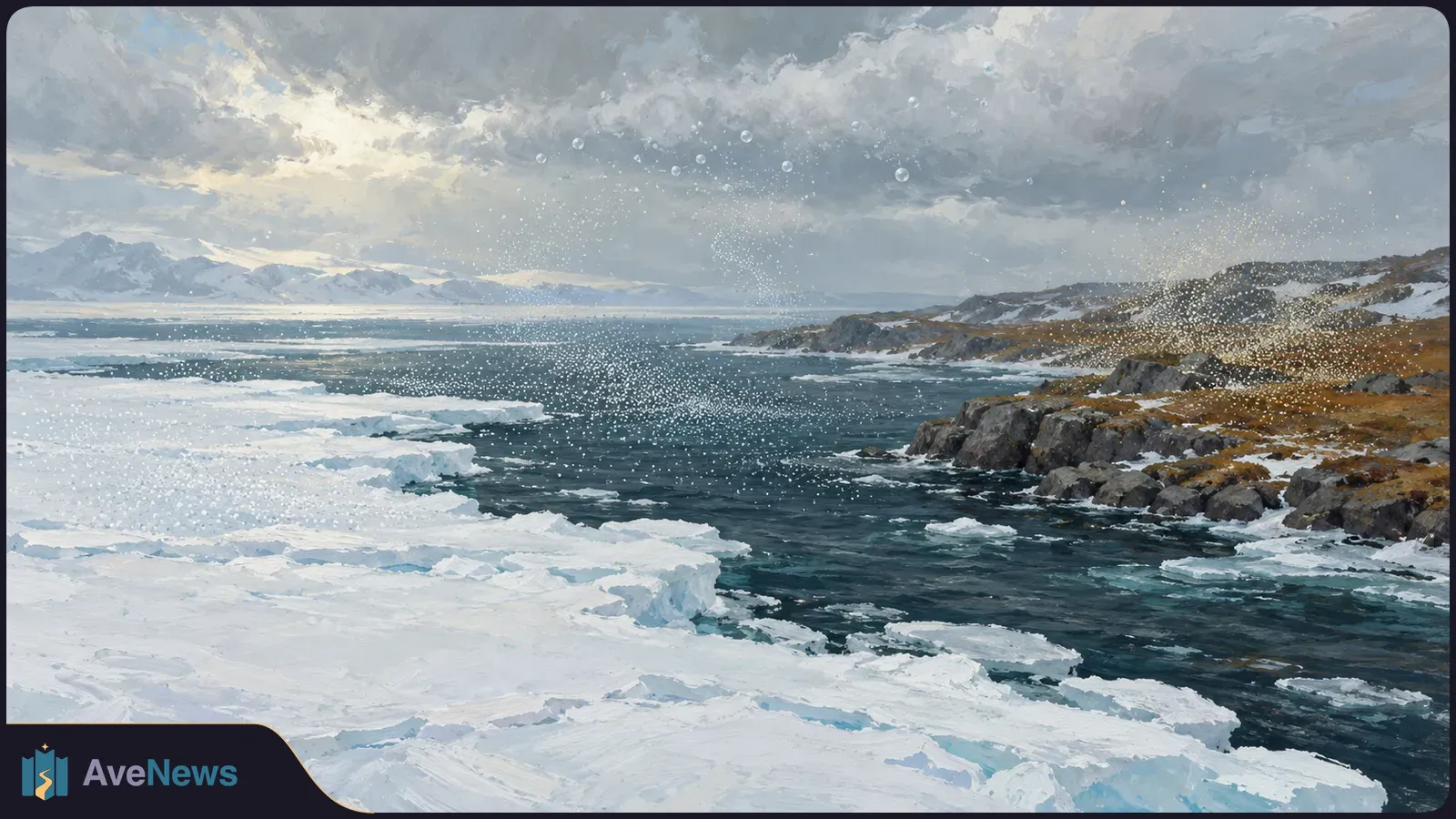
The study’s combined analysis reveals different links between particle-formation potential and cloud-forming particles across ice-covered, maritime and continental areas.
The study’s combined analysis reveals different links between particle-formation potential and cloud-forming particles across ice-covered, maritime and continental areas.
Arctic warming may increase the potential for new airborne particles to form in ice-covered northern areas while reducing it over open seas, according to temperature-only estimates in a study published in Nature Geoscience on September 28. The estimates suggest almost no change across a broad continental region. They concern particle formation, not actual cloud formation.
These particles matter because liquid cloud droplets form on airborne particles called cloud condensation nuclei. In clean polar air, the nuclei can sometimes be so scarce that they limit cloud formation. Understanding where they come from—and what limits their supply—is therefore important for understanding Arctic clouds.
New particle formation occurs when gases known as precursor vapours produce tiny particles in the atmosphere. Those particles must then grow to sizes suitable for acting as cloud condensation nuclei. This process is an important local source of cloud-forming particles in the Arctic.
But existing aerosols—airborne particles—also take up those vapours. Researchers call the rate of this removal the condensation sink. A stronger sink leaves less vapour available both to form new particles and to help them grow. More particles arriving from elsewhere can therefore supply cloud condensation nuclei while limiting the production of new ones locally.
The researchers applied consistent methods to particle measurements from Alert, Central Arctic, Pallas, Tiksi, Utqiaġvik, Värriö, Villum and Zeppelin. Together, the records span 2003–2024, but the locations have different periods of coverage. That uneven coverage limited direct comparisons to broad geographic and seasonal patterns.
The observations did not show a uniform increase in new particle activity. During a common 2010–2019 comparison period, condensation sinks declined across seasons. Yet increases in the small-particle concentration indicator met the study’s reported statistical threshold of p < 0.1 only at selected locations: Alert, Villum and Zeppelin in March–May, and Alert, Villum and Pallas in June–August. Apart from a summer increase in particle formation rates at Pallas, formation and growth rates showed no statistically significant changes at that threshold.
To map conditions more widely, the team developed an indicator called PotentialNPF. It estimates the potential for new particle formation events, represented by the daily peak above background in concentrations of particles 12.5–15 nanometres across. A nanometre is one billionth of a metre. The indicator does not measure whether those particles become cloud condensation nuclei or whether clouds actually form.
PotentialNPF combines monthly satellite measurements of ultraviolet radiation, water vapour, aerosol loading, vegetation and sea ice with surface air temperatures from a reconstructed weather dataset. These variables stand in for conditions affecting particle formation, including vapour supply and removal. The researchers produced monthly maps for 2006–2021 between 65° N and 83° N. The indicator uses a scale bounded by 0 and 100; it is not a percentage of cloud formation.
Analysis
The team grouped areas with similar patterns in PotentialNPF and a separately derived dataset of cloud condensation nuclei. That nuclei dataset included only clean continental and marine aerosols, representing natural background conditions rather than all particle sources. The grouping identified three aerosol regimes: High Arctic, Maritime Arctic and Continental Arctic.
The High Arctic broadly follows summer sea ice and snow-covered land, including Greenland and the Canadian Archipelago. There, higher new particle potential was associated with more cloud condensation nuclei. The authors interpret this as evidence that shared local processes influence both quantities, consistent with a contribution from locally formed particles. The association alone does not prove that new particle formation directly caused the increase in nuclei.
The Maritime Arctic covers open waters of the Barents and Norwegian seas. It had the highest particle formation potential of the three regimes and also showed a positive association with cloud condensation nuclei. The authors link this pattern to local processes: marine biological activity and sea-ice formation or melting can supply precursor vapours.
The Continental Arctic extends from Finland to the Lena Basin and includes parts of the Canadian Arctic. Its relationship between particle formation potential and cloud condensation nuclei was almost flat. The authors suggest that larger particles transported from lower latitudes, together with local human-caused emissions, probably sustain the nuclei supply. Those existing particles would also strengthen the condensation sink, suppressing local new particle formation.
Analysis
The researchers used the observed relationship between temperature and PotentialNPF to estimate how the indicator might respond to warming. They applied only projected temperature changes under SSP2–4.5, an intermediate-emissions climate scenario. These are temperature-sensitivity estimates, not comprehensive forecasts that account for every changing environmental condition.
| Regime | Average March–August level, 2006–2021 | Estimated change for 2090–2100 relative to 2006–2021 |
|---|---|---|
| High Arctic | 4.3 (3.7–5.6) | Increase of 0.9 (0.7–1.9) |
| Maritime Arctic | 20 (17–21) | Decline of 6.6 (6.5–8.3) |
| Continental Arctic | 3.7 (3.6–3.8) | Almost zero |
The authors propose different possible explanations for the regional responses. In the High Arctic, warming could increase precursor emissions through processes such as sea-ice melt. Over maritime areas, changing weather or ocean conditions could reduce formation potential. Higher temperatures could also make precursor compounds more likely to remain as vapour, while higher humidity could reduce particle formation or growth under some mechanisms. These are proposed explanations, not demonstrated causes.
The regional differences do not establish whether the resulting cloud changes would warm or cool the Arctic overall. Clouds can do either, depending on their altitude, structure and season. The unresolved climate question is how changes in particle formation translate into cloud properties—and how those clouds affect heat reaching and leaving the Arctic.
A consensus rule lets one country block a deal, while supply shocks and uneven production data complicate the dispute over what the treaty should cover.
5 min
The livestock disease has reached Scotland for the first time. Farmers report difficulty obtaining vaccines and extra work. People and food safety are not affected.
2 min
Feasibility studies and a cargo demonstration contract mark concrete steps, while ESA also explores access to future commercial stations.
3 min
