Gandak reaches record levels as floodwaters breach embankments
NASA’s satellite observations distinguish expected flooding of seasonal river-channel fields from water that breached embankments and reached settled areas in Nepal and India.
Torrential rain in Nepal pushed the Gandak River, also called the Narayani, to record levels, sending water over and through embankments and flooding farmland and settlements in Nepal and India. NASA Earth Observatory reported that the flooding extended along hundreds of kilometers of the river.
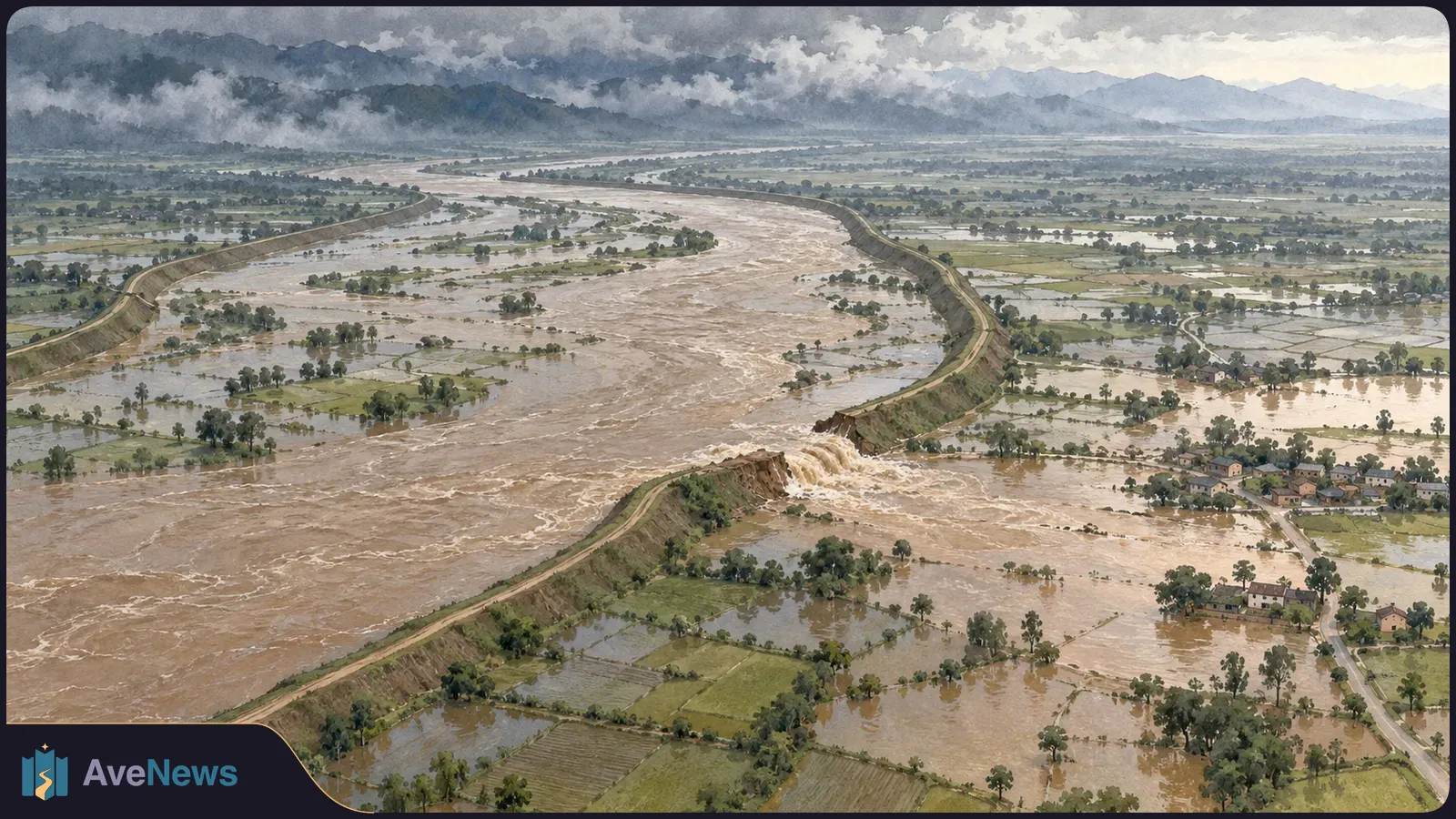
The rain drenched Nepal’s mountainous Lumbini and Gandaki provinces between September 24 and 27, 2026, late in the monsoon season. It triggered landslides and sent runoff into the river’s branching channels. In several areas, water overtopped or broke through embankments—the raised banks built to hold it back.
NASA compared images captured on September 20 and September 29 by MODIS imaging instruments aboard its Terra and Aqua satellites. The images combine infrared and visible-light observations to make water easier to distinguish: floodwater appears blue, vegetation bright green and clouds light blue.
Not all the submerged farmland represents unexpected flooding. Seasonal fields lie on low deposits of sand and silt within the river channel, known as diara, where flooding is expected. NASA distinguished those fields from settled areas reached after embankment breaches, including parts of Bagaha, Areraj and Fulia Khand.
The satellite view of the flooding is accompanied by a record river-level measurement. Data from Nepal’s Department of Hydrology and Meteorology, cited by NASA, showed that the Devghat gauge reached 11.94 meters on September 27. That was its highest reading since measurements began there in the 1960s. News reports cited by NASA also identified new high-water marks at India’s Bagaha, Dumariaghat, Rewaghat and Lalganj gauges along the Gandak.

News reports cited by NASA indicated that flooding and landslides had affected hundreds of villages and displaced thousands of people. Authorities were still assessing the full extent of the damage.
A Nature study used chains of up to 35 strontium atoms to test mathematical predictions about quantum transitions. The experiment measured both energy-level ratios and patterns revealed through individual-atom control.
3 min

A study of 133 adults found higher readings when the arm rested on the lap or hung unsupported. Proper support and cuff height matter, especially near a diagnostic cutoff.
3 min

Saturn’s opposition offers much of the night for viewing. Later in October, moonlight will obscure some Orionid meteors, and the Moon will pass near the Seven Sisters star cluster.
2 min
Correction ·
House style applied: Armenian punctuation, date and money forms.
Correction ·
Corrected spelling and punctuation in the Armenian text.