
Japan’s disused golf courses offer land for solar farms
Yale Environment 360 reports that cheap, flat sites with grid connections offer an alternative to foothill projects linked to forest loss and landslide risk.
Yale Environment 360 reports that cheap, flat sites with grid connections offer an alternative to foothill projects linked to forest loss and landslide risk.
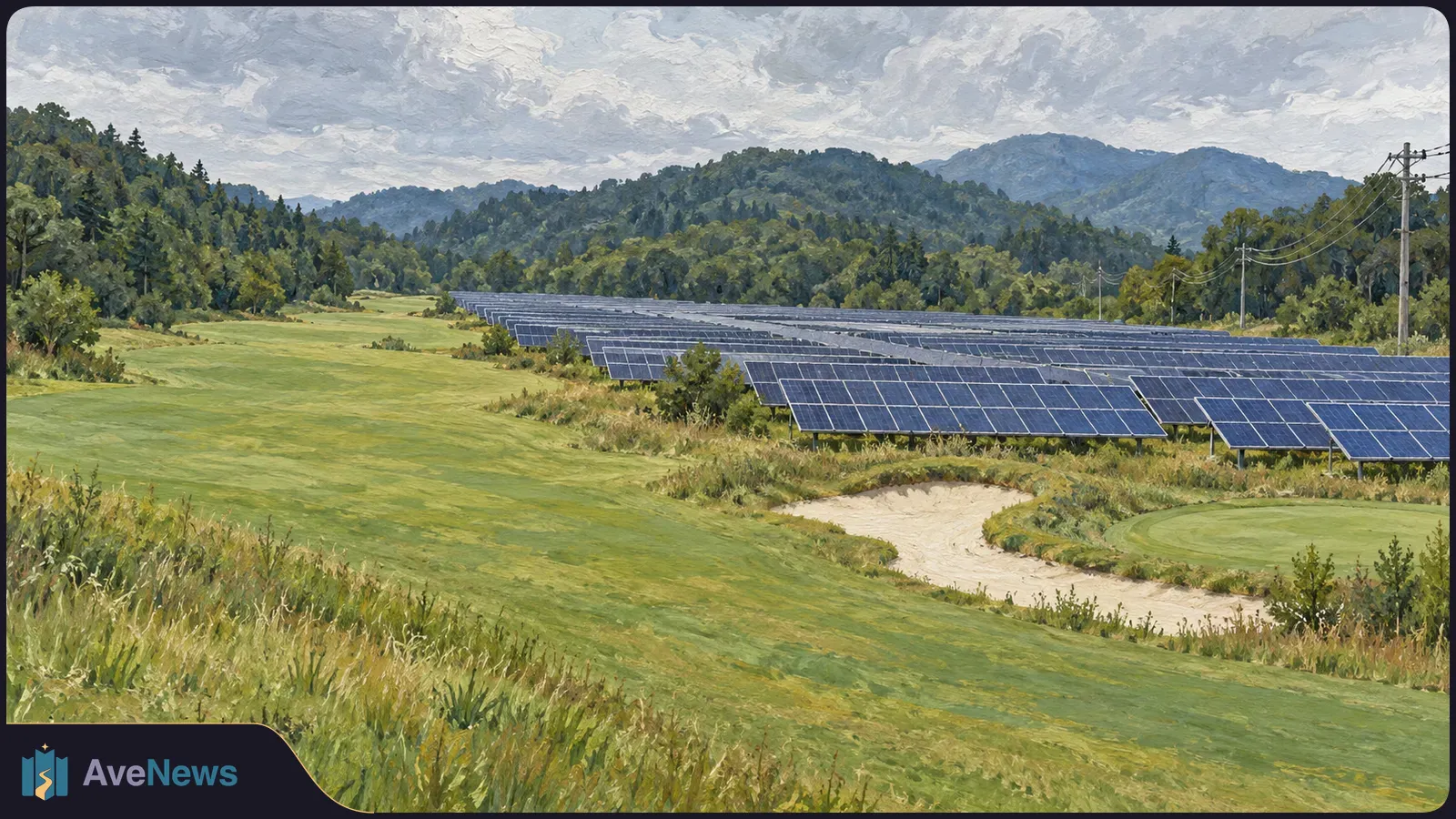
Developers in Japan are converting disused golf courses into large solar farms in a country where mountainous terrain and a dense population leave little land available for such projects. Former courses generally offer relatively cheap, flat land and existing connections to the electricity grid, Yale Environment 360 reported on September 28, 2026.
One example is the Kanoya Osaki Solar Hills plant in Kagoshima Prefecture, built on a former golf course. The conversions account for a substantial share of Japan’s utility-scale solar capacity—the generating capacity of large solar installations—according to Bloomberg’s analysis, as reported by Yale Environment 360.
| Project status | Share on golf-course sites |
|---|---|
| Installed | 9% |
| Announced or under construction | At least 10% |
Japan’s golf courses proliferated during the economic boom of the 1980s. Golf later declined in popularity, leading many courses to close and making their land available for other uses, the report says.
Solar development gained support after the 2011 Fukushima nuclear disaster. According to Yale Environment 360, public outcry prompted Japan to close dozens of nuclear reactors. Nuclear plants had previously supplied a third of the country’s electricity. To compensate for the lost generation, the government offered generous incentives to solar developers, driving a wave of large installations.
Developers have also built solar farms on abandoned farmland, including land in Fukushima made unusable by radioactive contamination. Many large projects have instead occupied foothills outside Japanese cities. Yale Environment 360 reports that those foothill projects have displaced forests and increased landslide risk, fueling public opposition.
Former golf courses offer another land-use option, but cheap land, flat terrain and grid connections do not establish the environmental merits of every site. How the environmental impacts of former golf-course projects compare with those of solar farms on other types of land remains unclear.

Supervised rover planning and orbital experiments are testing limited uses of SI. Space robots face another hurdle: learning how objects move in microgravity.
3 min

A University at Buffalo-led study points to a small chemical group on RNA’s sugar as a reason for the difference. Whether these droplets helped life emerge remains an open question.
The proposal would shorten the adult questionnaire from 482 questions to 150. HHS cites lower collection costs, while researchers warn that the cuts would worsen gaps in disability data.
2 min
