
Perseverance finds rocks at Jezero Crater’s edge were altered by water at least three times
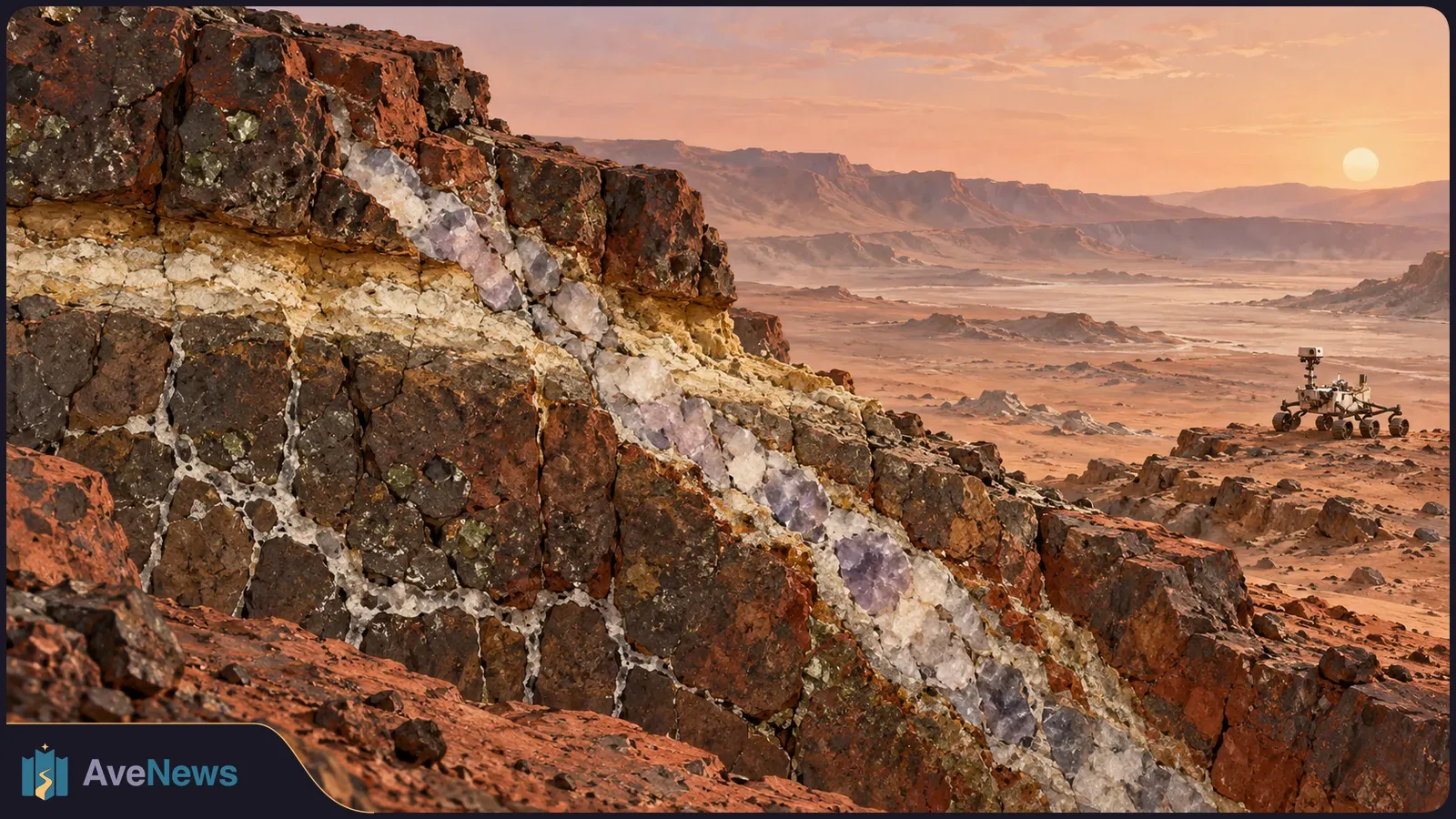
Scientists expected lake sediments at the old shoreline of a Martian crater. NASA's rover found igneous rock instead, and it records groundwater, lake water and later hot fluids.
Rocks along the edge of Jezero Crater on Mars were changed by water on at least three separate occasions, according to a new study of data from NASA's Perseverance rover. The first episode involved carbon-dioxide-rich groundwater. The second may have involved the lake that once filled the crater. The third involved hot fluids moving underground. Each episode changed the rocks' chemistry and appearance in a different way. The findings were published in the journal Communications Earth & Environment.
The area, called the Margin Unit, had been thought to record mainly the crater's lake. Instead, according to lead author Candice Bedford, a research scientist at Purdue University, it turned out to be "a sort of crossroads for aqueous systems", meaning several different water systems.
Perseverance reached the inner rim of Jezero Crater in September 2023. Researchers expected sedimentary rocks there, along the former shoreline of a Martian lake. Sedimentary rocks build up in layers over long periods, and on Earth those made from clay and silt can preserve evidence of ancient microbial life. Spacecraft orbiting Mars had also detected strong signals of carbonate minerals in the area. On Earth, carbonates commonly form in shallow lakes and oceans, including places that can support life.
Instead, the rover found igneous rock. This type of rock forms when magma cools underground or when volcanic material hardens at the surface. Its minerals can preserve detailed information about the conditions in which they formed. Bedford said the main hypothesis before the rover arrived, based on observations from orbit, was that the carbonate formed through contact with the lake.

Much of the evidence came from SuperCam, an instrument mounted high on the rover's mast. SuperCam can fire a laser at a rock from as far as 6.5 meters (21 feet) away. The laser creates a small burst of plasma, a hot glowing gas. The light from that plasma reveals which chemical elements the rock contains. Using this method, Perseverance has studied more than 185 bedrock targets across the Margin Unit, covering about 265 meters (870 feet) of elevation.
The rocks changed from the top of the area to the bottom. Higher up, the rover found coarse, crystalline rock rich in olivine, a mineral containing magnesium and iron. This rock showed almost no signs of contact with water. The researchers concluded that it formed deep underground inside a mass of magma, which cooled slowly enough for large mineral grains to grow. Erosion exposed the rock at the surface much later. Lower down, near the ancient lakebed, the olivine is heavily altered: its grains are fractured, and silica fills the spaces between them.
Analysis
Scientists looking for signs that ancient Mars could have supported life are especially interested in carbonate and silica. The reason comes from Earth. When water reacts with olivine, the reaction can produce hydrogen, which certain microbes can use as an energy source. The same reactions can also create carbonate and silica, minerals that can preserve traces of past microbial activity. This is a comparison with Earth. The study does not report evidence of life on Mars.
Bedford argues that the results matter beyond this site. "Jezero Crater sits inside one of the largest exposures of carbonate on Mars, so what we learn here reaches well beyond this crater," she said. The findings also show that some carbonate detected from orbit here formed from groundwater, not only from lake water. Bedford said she hopes the work will help scientists reconstruct how the climate of early Mars, and its ability to support life, changed over time.
The researchers can work out the order in which water altered the Margin Unit. However, they cannot yet determine when each episode happened. The link between the second episode and the lake is also described as a possibility, not a certainty. For now, the study establishes the sequence of these three water episodes, but not when they happened.
Lily Grigoryan moved from the US to Armenia in 2024 and planned to stay. She told Hetq she went back because Armenian pharmacies could not reliably supply medicines for her autoimmune diseases. Of the 10 medicines she needs, only three were easy to find.
4 min

The four astronauts returned after a delayed crew change at the International Space Station.
5 min

The holographic principle says that everything inside a region of space might be fully described by information on its surface. A Quanta Magazine essay separates the math behind the idea from open questions about whether it applies to our universe.
7 min