Biology may not be quantum, but some living networks may copy quantum math
Biology may not be quantum, but some living networks may copy quantum math
SI
Princeton chemist Gregory Scholes once saw signs of quantum effects in photosynthesis. He now argues that large networks of ordinary vibrating parts can produce states that follow quantum mathematics without being quantum at all.
For about two decades, some scientists have hoped that living things might use quantum effects, the strange behaviour of the smallest particles, to do their work. Gregory Scholes, a chemist at Princeton University, was among those excited by the idea. Quanta Magazine reports that he is now skeptical that quantum effects play a role in life. He proposes that life might be imitating those effects rather than using genuine ones.
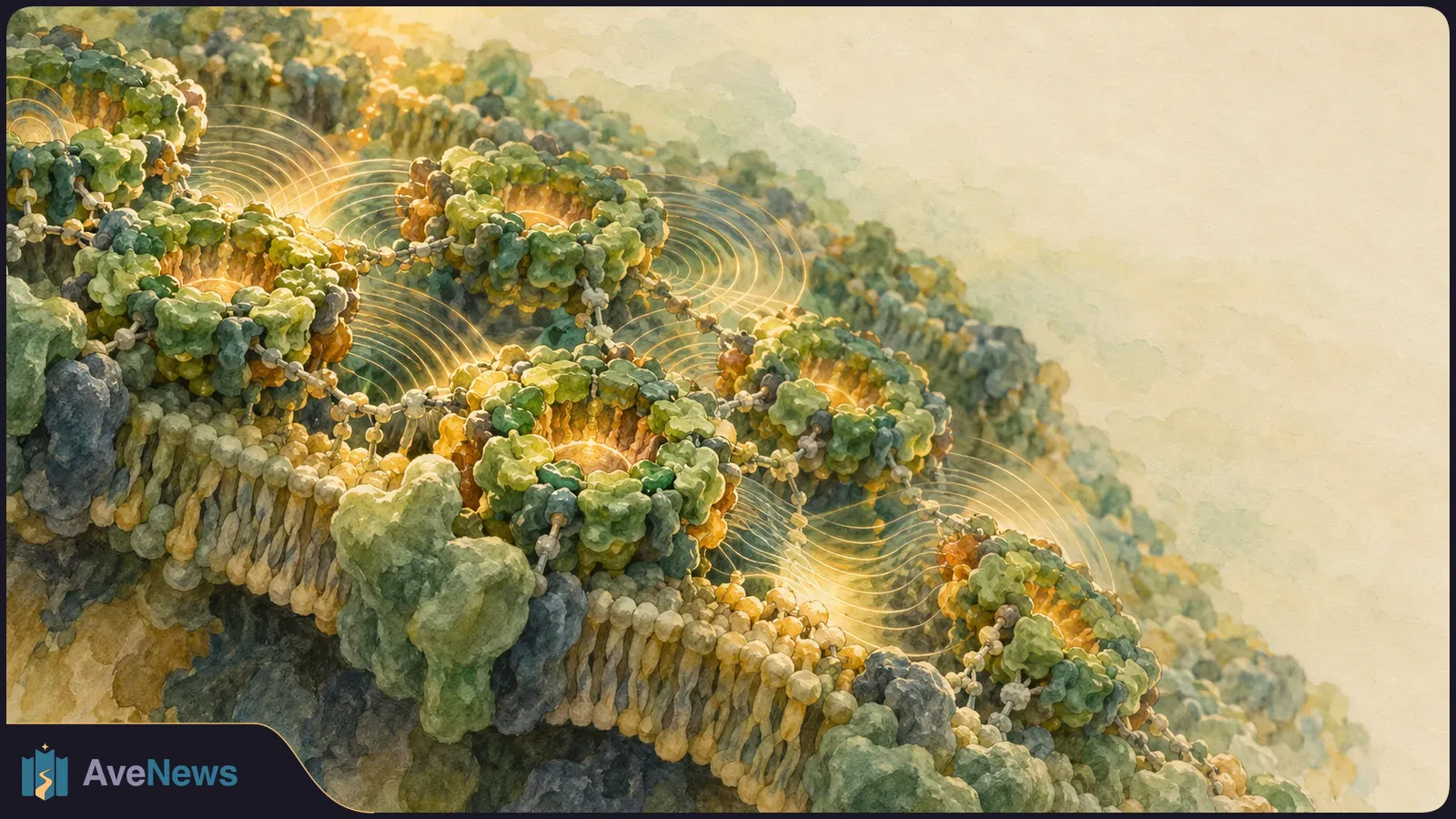
In several papers published over the past three years, Scholes and colleagues have shown that complex networks of ordinary, classical objects can produce behaviour that mathematically mimics quantum objects. The resulting states are not truly quantum. The source calls them only "quantumlike." They appear when many interacting, oscillating parts add up to a collective whole whose behaviour obeys the same mathematics physicists use to make predictions about the quantum world.
Maybe quantum biology, at the biggest scales, means using 3 1/2 billion years of evolution to work out how to get the functionality that you could get from quantum systems.
Why quantum effects are hard to keep alive in a cell
A quantum particle does not sit in one definite state. It can exist in a superposition, a blend of several possible states at once, which behave like overlapping waves. When these waves are orderly enough to reinforce or cancel one another, the states are called coherent. Coherence is delicate. Even a small amount of environmental noise, such as the jiggling of atoms caused by heat, can destroy it. Physicists call this decoherence. Inside a warm, wet cell, decoherence should be essentially instantaneous.
Some quantum behaviour does happen in cells. Very small particles such as hydrogen atoms can "tunnel" through energy barriers they could not otherwise cross, and there is evidence that tunnelling helps explain why some enzymes react so quickly. But this tunnelling involves no long-lived coherence, and it happens even in a flask of non-living chemicals. The question quantum biologists care about is whether life can hold coherence long enough to use it as a resource.
The photosynthesis result that did not hold up
Photosynthesis was the most promising case. Plants and some bacteria capture light with arrays of pigments and proteins called light-harvesting complexes. Almost every photon they absorb ends up powering photosynthesis. Scientists thought that if the absorbed energy stayed quantum-coherent, it could explore several routes to its destination at once instead of wandering and getting lost.
In 2007, Graham Fleming of the University of California, Berkeley, hit a bacterial light-harvesting complex with extremely fast laser pulses and saw synchronized "beats." At the time, the beats looked like evidence of quantum coherence. Other researchers, including Scholes, found similar beats, even in experiments at room temperature.
On closer examination, beats like the ones Fleming's team described turned out to reflect a resonance between vibrating molecular bonds, not quantum coherence. Scientists are still working out that resonance, but it is not long-lived, long-range coherence. Researchers have proposed quantum effects in other areas, such as the magnetic sense that helps birds navigate, with varying amounts of supporting evidence. According to Quanta, there is still no definitive proof of any long-lived quantum coherence with a biological function.
Analysis
How ordinary oscillators can follow quantum math
Mathematically, a quantum state is a vector: an ordered list of numbers that marks a position in a space of possibilities called a Hilbert space. Those numbers also carry a wave's phase, meaning how its peaks and troughs line up. Phase determines whether two waves add up or cancel out, which is what interference means.
In 2024, Scholes found a way to design networks of oscillators, meaning parts that repeat a regular motion, so that they settle into stable synchronized patterns, like a crowd clapping in time. These patterns can be described as vectors in a Hilbert space. In particular, the networks can mimic a qubit, the simplest quantum unit, which has two states (like 1 or 0) and can exist in a superposition of both. Ethan Dickey, a computer scientist at Purdue University, said the effect arises strictly from the mathematical structure of the network.
The article cautions that similar mathematics does not mean similar physics. A flying baseball and the tip of a cactus spine both trace arcs described by quadratic equations, but different forces shape them. In the same way, a mathematical link between classical and quantum systems is not a physical one.
Analysis
Possible uses, and a steep cost
In follow-up work, Scholes and colleagues showed that quantumlike bits can be wired into bigger networks that stay quantumlike. They also showed how a network could mimic a quantum logic gate, a circuit that performs a simple computation. Dickey and his doctoral co-supervisor Sabre Kais, a quantum chemist at North Carolina State University, see "strong potential for practical applications" in quantum machine learning and in modelling complex systems.
Those uses face a real barrier. The complexity of the network blows up as quantumlike bits are wired together. To perfectly mimic quantum logic gates, Scholes said, "you need to have infinite resources, physical resources." Dickey is looking for computationally efficient ways to produce these states. In 2026 he published work showing that networks can be designed to produce more kinds of quantum states than Scholes' original framework allowed.
Related ideas are reaching brain research, a field where quantum claims have been heated. Roger Penrose's 1989 proposal that consciousness arises from quantum effects in the brain is taken seriously by few neuroscientists. Wolf Singer, a neurophysiologist at the Ernst Strüngmann Institute of the Max Planck Society, was at first skeptical of quantumlike modelling. In 2025, he and colleagues showed that adding oscillations to a particular kind of simple neural network made it more efficient and robust. Singer said interference gave the network a new dimension to work with, time, because an oscillation's phase encodes how events are arranged in time relative to each other.
A warning about words, and the open question of entanglement
Ebrahim Karimi, a physicist at the University of Ottawa, praises Scholes' framework for its elegance and says it could be useful. He also warns against putting too much weight on the mathematical link and thinks quantum vocabulary does not belong anywhere near classical systems. Interference, he points out, is not mysterious or quantum. It is simply how waves behave.
Researchers want to learn when and how classical systems can mimic quantum math. According to Quanta, that knowledge could help sort out disputed claims about quantum effects in living things, including in the brain. Scholes is now working to find out whether classical systems can meaningfully mimic entanglement, the quantum link that lets separate particles share a single state.
Yerevan had earlier talked with French and Portuguese companies. The winning group is led by a Chinese energy firm with at least two failed projects, one of them in Armenia. The deal's money terms and timeline have not been published.
The court extended the former Armenian finance minister’s custody by two months. His German surgeon says he urgently needs spinal surgery abroad, while state experts dispute the need and say an indicated operation could be performed in Armenia.
On 23 September, Smile was approved to begin science operations. Its ultraviolet camera is already recording the northern lights. Its X-ray camera is still picking up too much stray light, and ESA expects that to ease by mid-October.