
Researchers reconstruct an exciton’s changing spatial structure
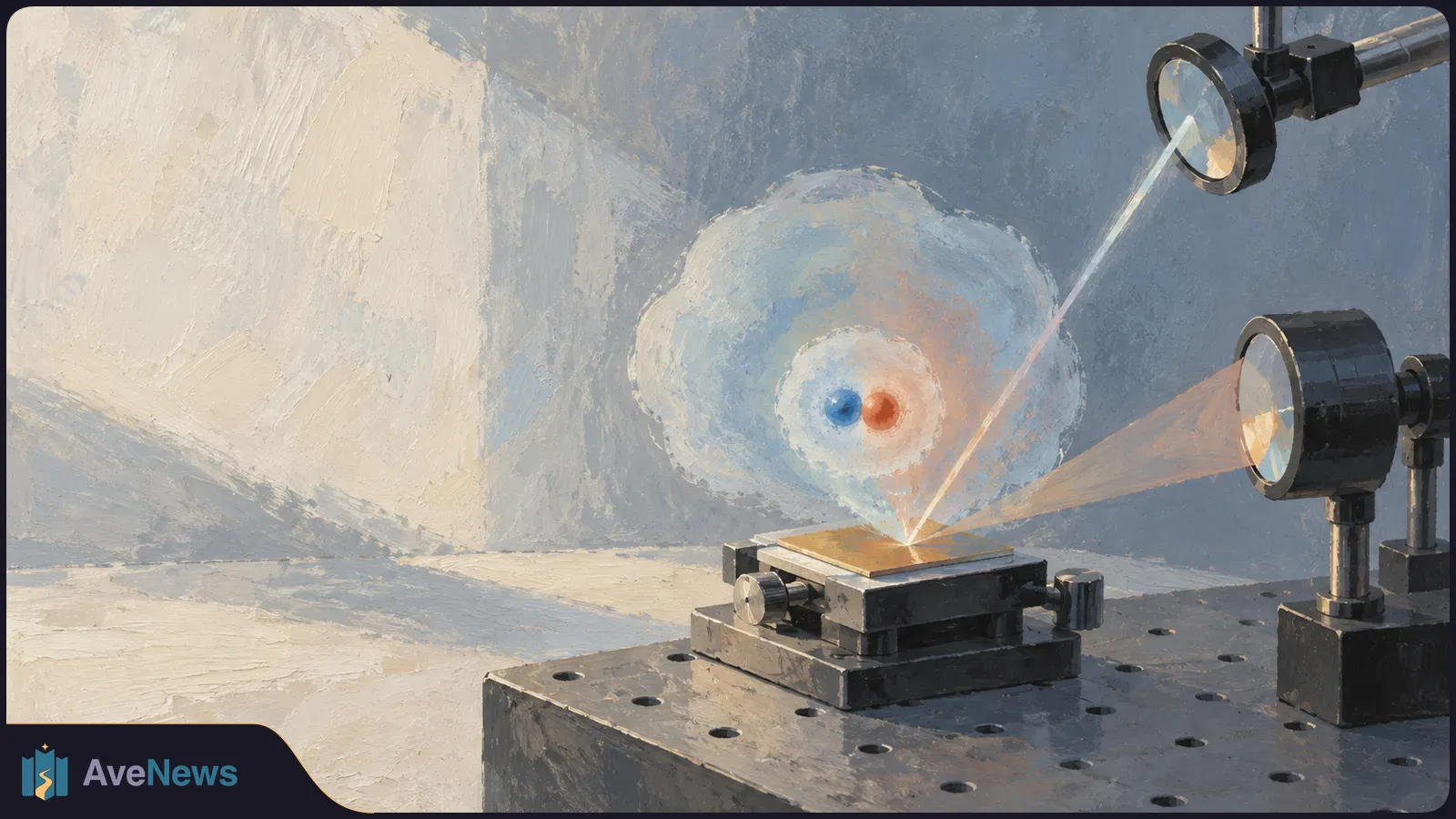
Ultrafast laser measurements and theoretical models revealed how a short-lived electron–hole pair contracted in an organic semiconductor—not through direct photography.
Ultrafast laser measurements and theoretical models revealed how a short-lived electron–hole pair contracted in an organic semiconductor—not through direct photography.
Researchers reconstructed the spatial structure of an exciton—a short-lived pairing of an electron and a positively charged hole—and followed how it contracted after forming. Physics World described the work in its October 1 report as the first experimental reconstruction of an exciton's quantum probability distribution. The method offers a way to study spatial changes that occur too quickly for standard spectroscopy.
Peter Puschnig of the University of Graz in Austria led the team, working with colleagues at Marburg University and Forschungszentrum Jülich in Germany. Their study, detailed in Physical Review X, examined films of alpha-sexithiophene, an organic semiconductor used in applications such as solar cells.
When a material absorbs light, the light's energy can move an electron into a higher-energy state. The electron leaves behind a hole: an absence of an electron that acts as a positive charge. The excited electron and hole can bind together as an electrically neutral exciton. Physicists call this a quasiparticle because the pair behaves as a single entity within the material.
Excitons help explain how materials absorb and use light, but their brief existence makes them hard to examine. Excited electrons can return to their original states within picoseconds—trillionths of a second. Standard spectroscopy cannot simultaneously measure the exciton's spatial extent and momentum distribution quickly enough within that interval. Momentum is a quantity describing motion.
The team used time-resolved photoemission orbital tomography. This combines a pump–probe experiment—one pulse creates the state and another examines it—with momentum microscopy, which maps the momentum distribution of emitted electrons. Its time resolution reaches femtoseconds, or quadrillionths of a second.
An ultrashort first laser pulse created excitons in the alpha-sexithiophene film. A second, higher-energy pulse ejected electrons from those excitons, a process called photoemission. The researchers measured the ejected electrons' energy and direction. Changing the delay between the pulses let them examine the exciton at different times after its creation.
Those measurements were not photographs of the exciton. As Puschnig explained, theoretical models allowed the team to infer the electrons' quantum state from their measured energy and direction. The researchers used computationally intensive ab-initio calculations—calculations based on fundamental physical principles—to interpret the data. The resulting reconstruction describes the exciton's wavefunction, a mathematical description of its quantum state that includes information about its spatial probability distribution.
The team reported that the exciton initially extended about 1.5 nanometres, roughly the span of three molecules. Within 400 femtoseconds of its creation, its size contracted by about 25%. This result describes a change in the reconstructed quantum structure, not a solid object shrinking. The precision of the reported size and contraction estimates remains unclear.
The researchers want to extend the method from this relatively simple exciton to more complex materials. One target is charge separation in organic solar cells: the process in which an electron and hole begin to move apart after light absorption. Puschnig describes that separation as the crucial step between absorbing light and generating usable electrical current.
The team hopes to observe how a material's molecular and electronic structure controls that process. Better understanding could eventually help improve organic solar cells, according to the researchers. That is a research prospect, not a demonstrated improvement in a device.
Repeated measurements during long space-station missions found a return toward preflight heart measures among exercising astronauts. The findings do not prove exercise caused recovery or guarantee readiness for Mars.
3 min

A separate 7% of people renewing coverage under the rules lost their insurance. Most denials and losses followed unanswered verification requests.

The French nonprofit wants EU funding to remove these vessels from fishing. An industry association argues that large boats can be efficient and sustainable.
3 min
3 min
