
NASA reports steady pointing and focused images in Roman telescope tests
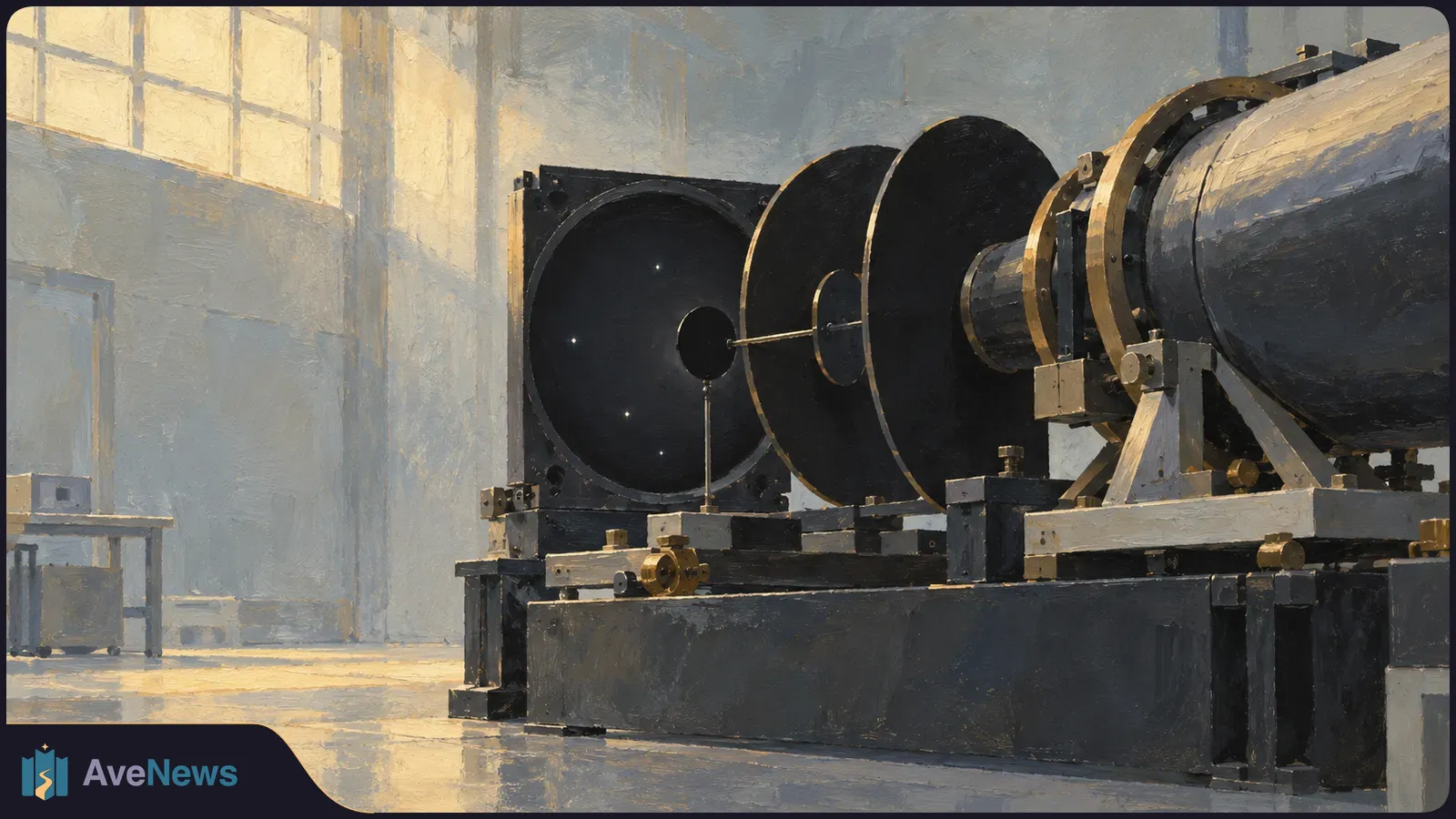
September tests checked the stability needed to observe faint planets, but the coronagraph’s first images showed stars—not planet detections.
NASA’s Nancy Grace Roman Space Telescope maintained extremely steady pointing in September tests, and its Coronagraph Instrument produced its first focused images of stars. NASA team members described the results in an October 2 ScienceDaily report. The tests checked capabilities needed for future observations of much fainter planets, rather than demonstrating planet detection.
Engineers tested Roman’s fine-guidance system—the system that tracks reference stars to help correct small pointing errors—from September 15 to 21. They then tested it together with the coronagraph on September 22 and 27.
Roman’s attitude control system first turns the spacecraft toward the required area of sky. Small sections of the Wide Field Instrument’s 18 detectors then track different guide stars whose positions are precisely known. These stars provide reference points for measuring tiny movements during an exposure—the period when the instrument collects light to make an image.
The fine-guidance system reports the stars’ positions about four times a second, allowing attitude control to make small corrections when needed. Begoña Vila, identified in the October report as Roman’s guiding instrument systems lead at NASA’s Goddard Space Flight Center, said exposures can last from minutes to hours. Those corrections help Roman remain steady enough to produce its sharpest images.
Vila said NASA’s tests confirmed the following pointing stability:
The coronagraph is designed to demonstrate technologies that suppress bright starlight, allowing scientists to study much fainter planets and dusty disks around nearby stars. Vila said it also has its own internal stabilization process. That extra control matters because even tiny vibrations or pointing errors can let starlight leak into an image and overwhelm a faint planet.
The coronagraph received light from space for the first time on September 22, observing a faint star in the Large Magellanic Cloud, a neighboring galaxy. After checking the telescope’s stability, the team adjusted the instrument’s focus. Vanessa Bailey, identified in the October report as a Roman Coronagraph Instrument scientist at NASA’s Jet Propulsion Laboratory, said the observation confirmed that the instrument could produce a focused image.
It's a very limited test that kicks off a methodical process of increasingly complex tasks that help us prepare for the instrument's future observations.
The first image contained extra noise—unwanted signal in the image—because the detectors were deliberately kept warmer than their eventual operating temperature. Keeping them warm at this stage helped prevent contamination from sticking to them. For the second observation, the team cooled the detectors to improve sensitivity and viewed another part of the Large Magellanic Cloud. Bailey said the expected multiple stars appeared, confirming that Roman was pointing where the team intended.
Roman has no separate guider instrument. The team also plans to guide it using spectra: patterns showing how an object’s light is distributed across different wavelengths. Rather than tracking only a star’s point-like image, this mode would use the spectral information Roman is designed to collect for science to help maintain its position.
In the October 2 report, Vila said the team expected to validate spectral guiding in the coming weeks. The completed September checks established stability, focus and pointing; more demanding coronagraph tests remain part of the instrument’s preparation for future observations.
A comparison found that microraptorines and the bird lineage shared some flight-related traits, but acquired them in different orders.
2 min
The October 1 retraction notice says unintended RNA splicing likely produced the signal that the 2014 study interpreted as frameshifting.
2 min
Computer models and a test with 100 volunteers suggest how visible wings could disrupt a predator’s aim, but effects on attacking birds remain uncertain.
3 min